Quick answer
Choose an LT distribution box manufacturer by checking six things against your utility’s tender: the IS standards cited, the enclosure material, the IP rating, valid type-test reports from an accredited lab, the make of internal components, and routine and acceptance test records. Utilities specify these differently, so the tender, not a brochure, is the reference.
What is an LT distribution box?
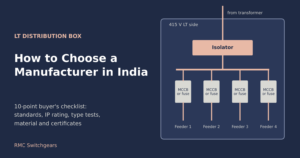
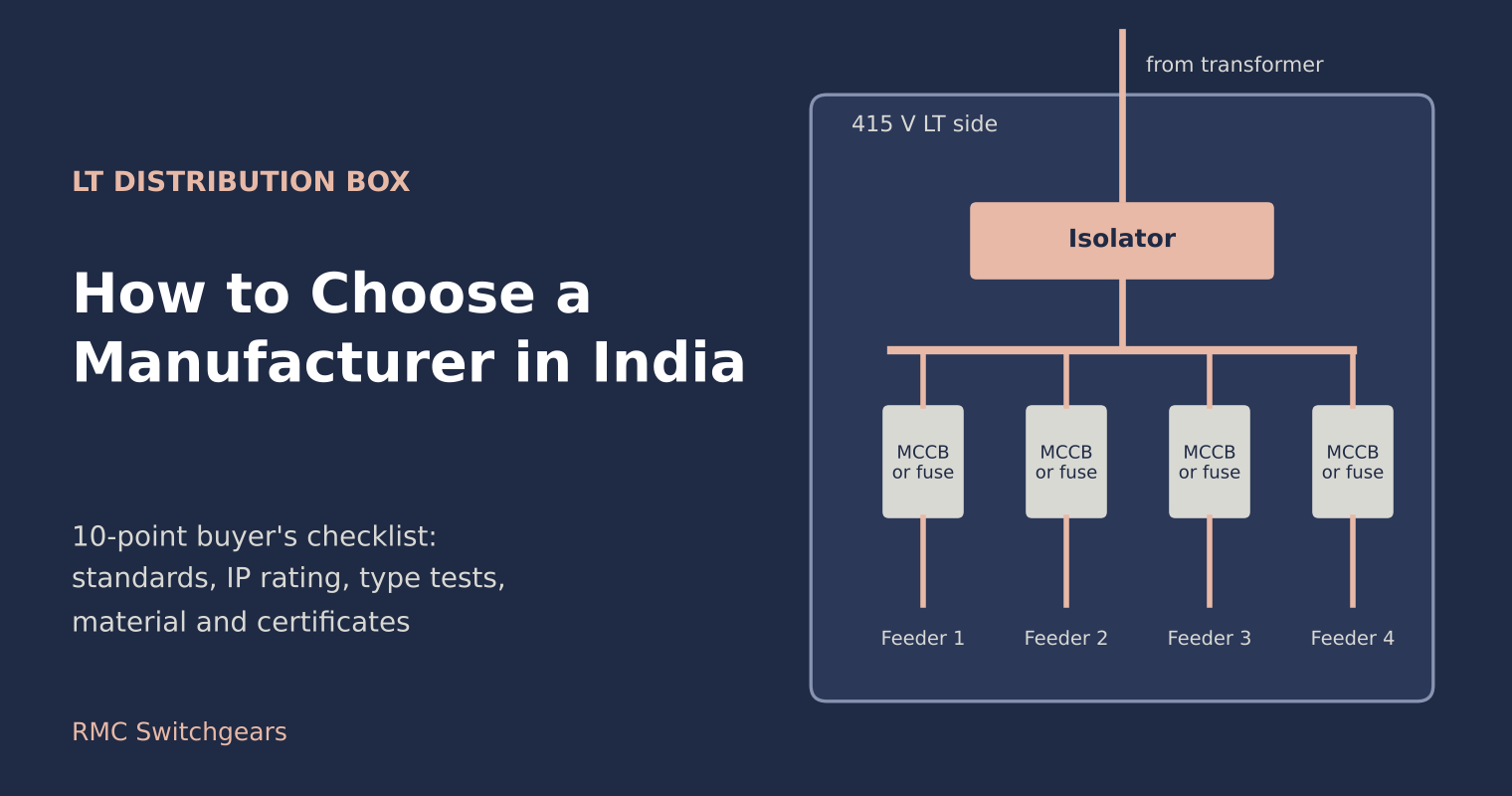
An LT distribution box sits on the low-voltage side of a distribution transformer and feeds the outgoing LT lines. Utility specifications cover boxes for transformers of 63, 100 and 200 kVA, fitted with MCCBs or fuse units. A wrong choice shows up as water ingress, nuisance tripping, tampering or a rejected consignment, so the manufacturer matters as much as the product.
What do Indian utilities actually specify?
There is no single national requirement. The table compares four published specifications. Use it to see how much the numbers vary, then read your own tender.
| Utility specification | Enclosure | IP rating | Type-test report age |
|---|---|---|---|
| MSEDCL, SMC LTDB with MCCB (urban) | SMC, 3 mm, IS 13410 | IP-33 (IS 8623) | Certificates from the last 10 years |
| PGVCL, SMC box with HRC fuse | SMC, IS 13410 | IP-42 (IS/IEC 60529) | Not older than 7 years at tender opening |
| WBSEDCL, LT distribution kiosk | SMC, minimum 3 mm | IP-44 (IS 12063) | Not more than 5 years old at tender date |
| WBSEDCL, distribution box (2019) | CRCA mild steel, 2 mm | IP-33 (IS 8623) | No period stated; NABL-accredited lab required |
Sources: MSEDCL, PGVCL, WBSEDCL kiosk and WBSEDCL box specifications. Specifications are revised, so confirm the current version.
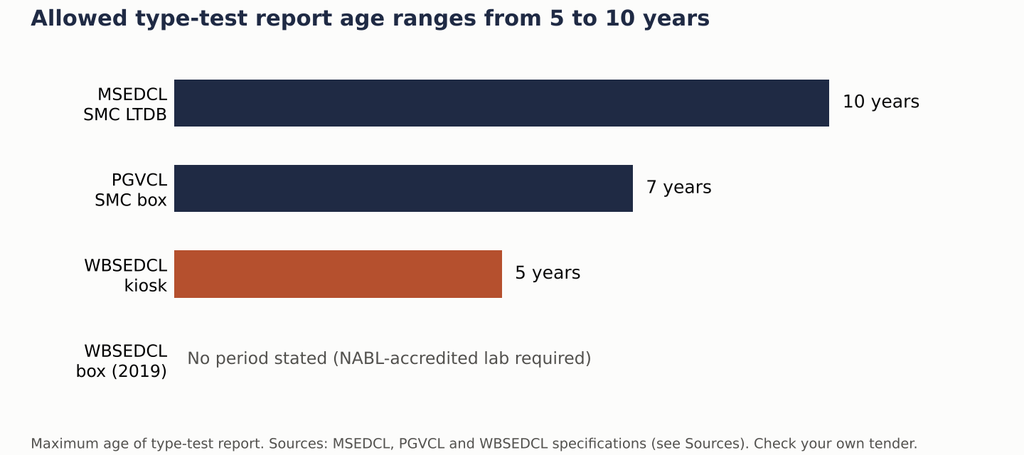
Figure 1. Maximum type-test report age in four published specifications.
What is the difference between type, routine and acceptance tests?
Type tests prove that a design meets the standard. An accredited laboratory runs them once on a representative box, and the report is your evidence. Routine tests are run by the manufacturer on production units, and the records must be kept. Acceptance tests are run on samples picked at random from your consignment before it is accepted. PGVCL, for example, specifies acceptance tests on 2% of the offered quantity. A supplier needs all three, and a type-test report alone does not prove that the box you receive matches it.
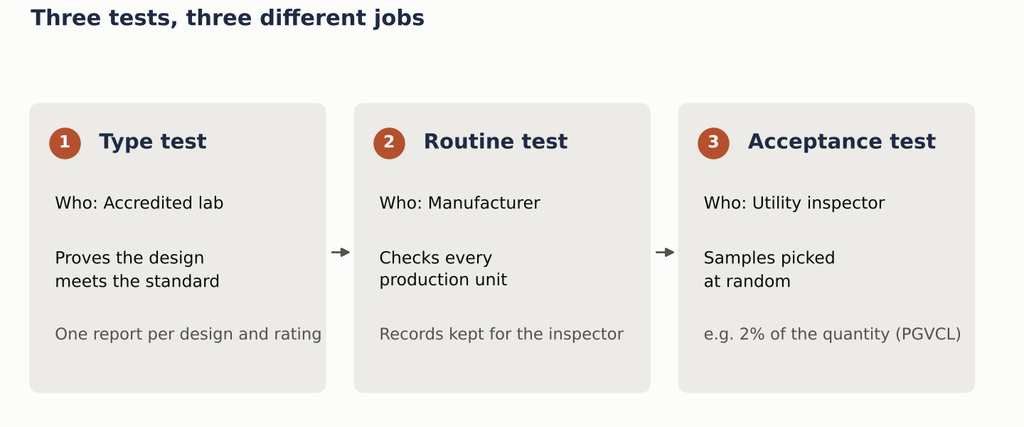
Figure 2. Type, routine and acceptance tests do different jobs.
The 10-point buyer’s checklist
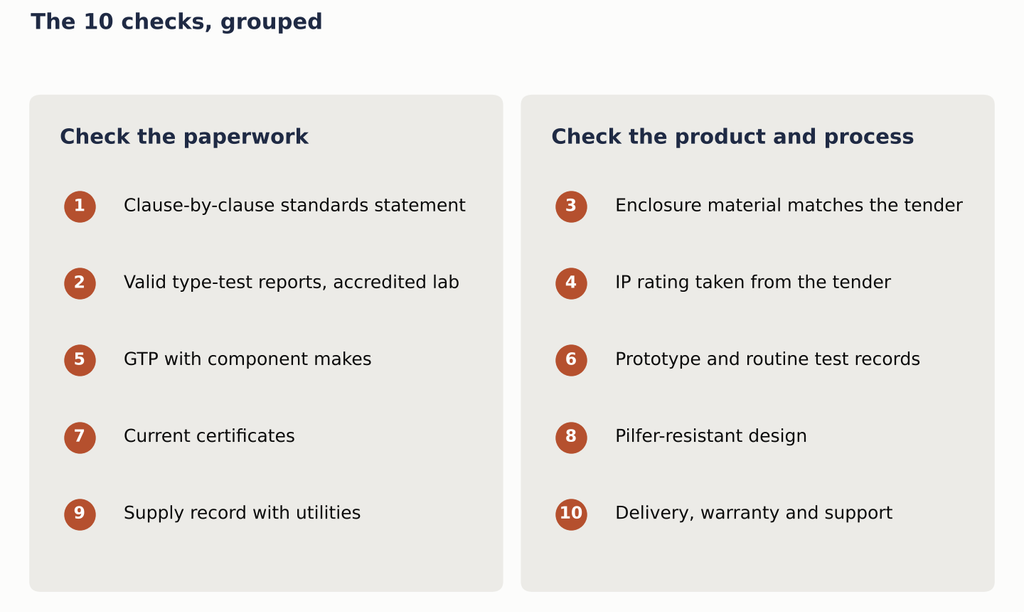
Figure 3. The 10 checks, grouped.
1. Ask for a clause-by-clause standards statement
MSEDCL’s specification cites IS 13947 Part 3 for the isolator, Part 2 for LT MCCBs, IS 8623 for the enclosure and IS 13410 for the SMC material. Ask the supplier to map every tender clause to its product, rather than accepting a line that says “conforms to IS”.
2. Demand valid type-test reports
This is where many offers fail. The allowed age ranges from 5 to 10 years across the specifications above. MSEDCL and WBSEDCL both state that reports from the manufacturer’s own laboratory are not acceptable, and require NABL-accredited labs. Check that the report covers your exact rating and design.
3. Match the enclosure material to the tender
The specifications differ: SMC at 3 mm in MSEDCL’s box and WBSEDCL’s kiosk, CRCA mild steel at 2 mm in WBSEDCL’s distribution box. Neither wins everywhere. Our guide to mild steel, stainless and SMC in an Indian monsoon and our FRP vs steel procurement comparison explain how each ages in the field.
4. Take the IP rating from your tender
The examples above run from IP-33 to IP-44. Do not over-specify: a higher rating adds cost without helping if the tender does not ask for it. Ask whether the tested sample used the same gasket and door design as the box you will receive. See why outdoor equipment needs weatherproof enclosures.
5. Get the guaranteed technical particulars (GTP)
MSEDCL’s specification requires makes and types of components to be stated in the GTP, with the final selection subject to its approval in the purchase order. A good bidder lists every make and rating without being asked.
6. Check prototype approval and routine testing
MSEDCL requires the successful bidder to make three prototype boxes of each ordered item, which it may inspect within 15 days of notice, without prior intimation. PGVCL requires routine tests during production, with records kept for the inspector, and acceptance tests on 2% of the offered quantity.
7. Verify certificates are current
Ask for the actual certificate with its dates. IAF’s decision states that all ISO 9001:2008 certificates expired on 15 September 2018, so a valid ISO 9001 certificate today is to the 2015 edition. Source: IAF decision, via RvA.
8. Look for a pilfer-resistant design
PGVCL asks for at least three concealed stainless-steel hinges so the box is pilfer-resistant, and a stainless-steel clamp with holes for sealing. WBSEDCL’s box specifies a removable handle and a central lock with brass levers. Read more in our guide to anti-theft meter boxes.
9. Review the supply record
Ask for purchase orders or approvals from the last two to three years, ideally from your own state. A supplier that has passed your utility’s inspection knows its process.
10. Compare delivery, warranty and support
Confirm lead time for your quantity, warranty period, replacement terms and who handles site issues. A low price with weak documentation often costs more in rejections. Our guide to reading an RDSS tender covers how risk is shared.
How should you shortlist suppliers?
- Read your tender first. Note the standards, material, IP rating, test-report age and accepted laboratories.
- Send a document request. Ask for type-test reports, the GTP, current certificates, routine test records and supply references.
- Check every report. Confirm the lab, the date, the rating and the design match your order.
- Inspect before you commit. Visit the factory, ask for a prototype where your utility requires one, and watch routine tests.
Red flags
- Test reports that are expired, from an unaccredited lab, or for a different rating.
- Reports from the manufacturer’s own laboratory, which MSEDCL and WBSEDCL do not accept.
- Reluctance to share the GTP or component makes.
- An ISO 9001:2008 certificate presented as current.
- No routine test records and no access for a factory inspection.
Where RMC Switchgears fits
RMC Switchgears, based in Jaipur and building enclosures and distribution equipment since 1994, lists LT distribution boxes and SMC LTDBs among its products. Use this checklist on us too: ask for our type-test reports, GTP and certificates. To see what poor LT-side equipment costs a utility, read about distribution transformer failure.
Frequently asked questions
Which standards apply to an LT distribution box in India?
Utility specifications typically cite IS 13947 Part 2 for LT MCCBs, Part 3 for isolators, IS 8623 for the enclosure, and IS 13410 for SMC material. Follow the exact list in your tender.
SMC or mild steel: which is better for an LT distribution box?
It depends on the tender and the site. MSEDCL’s box and WBSEDCL’s kiosk specify SMC, while WBSEDCL’s 2019 distribution box specifies CRCA mild steel. Compare lifecycle cost as well as price.
How old can a type-test report be?
It varies by utility: within 10 years for MSEDCL, not older than 7 years for PGVCL, and not more than 5 years for WBSEDCL’s kiosk. Check the clause in your tender.
Which IP rating should an LT distribution box have?
Use the rating in your tender. Published examples include IP-33, IP-42 and IP-44.
How do I verify a manufacturer’s ISO certificate?
Ask for the certificate showing the standard edition, scope and validity dates, and confirm it with the issuing certification body. ISO 9001:2008 certificates expired on 15 September 2018.
What documents should I request before ordering?
Type-test reports, GTP with component makes, current certificates, routine test records, supply references and warranty terms.
Sources
MSEDCL, LT Distribution Box SMC with MCCB (urban)
PGVCL, Technical Specification of SMC Box with HRC Fuse
WBSEDCL, Technical Specification of LT Distribution Kiosk