A transformer can pass its 11 am round and still run above its rating every evening until the next one. The reading was accurate. It just was not the reading that mattered.
Quick answer
Distribution transformer monitoring tracks four conditions that scheduled rounds see only as single readings: time above rating, phase imbalance drift, leakage current trend and thermal cycling. Each is a trend, and a round produces a point. Monitoring does not replace rounds or extend transformer life. It changes when you find out.
Key takeaways
• Scheduled maintenance works. Transformers fail on condition, and condition changes between rounds.
• Four signals build up between visits: time above rating, phase imbalance drift, leakage current trend and thermal cycling.
• Scale monitoring to the asset and to the people it serves, not to a blanket rule.
• Monitoring does not replace rounds and does not extend transformer life.
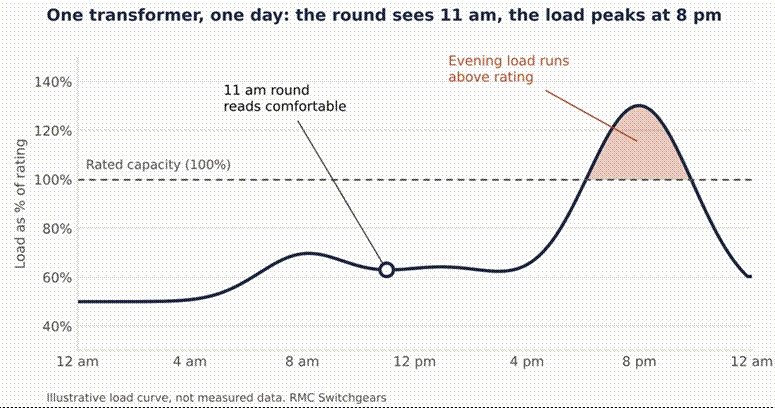
Figure 1. A round reads one point on the day’s load curve. Illustrative, not measured data.
Why do scheduled rounds miss problems?
Scheduled maintenance exists because it works. Crews find loose fittings, oil leaks and damaged cables that no sensor sees. But a schedule runs on the calendar, while a transformer’s condition runs on load, weather and time. A round sees each condition as a single reading, taken at a convenient hour in daylight.
The table below shows what a round sees against what a trend shows, for each of the four signals.
| Signal | What a round sees | What a trend shows |
| Time above rating | Load at the hour of the visit | Hours per day above rating, across seasons |
| Phase imbalance drift | Phase currents on one day | How the spread changes month to month |
| Leakage current trend | One clamp reading, if taken | Whether the figure is steady or climbing |
| Thermal cycling | Today’s temperature | Daily swing, and how many days it is large |
Signal 1: How long does the transformer run above its rating?
Winding insulation ages with temperature and time. The IEC 60076-7 loading guide links operating temperature and load to transformer life, which is why hours above rating matter more than the peak figure. A reading at 11 am can look comfortable while the evening load does the damage. On a residential feeder, the demanding hours come after dark, when few crews are out. Track load current against rating, and count the hours per day it stays above.
Signal 2: Is phase imbalance drifting?
Networks grow one connection at a time, and new single-phase loads go where the demand is. The balance set at commissioning slowly disappears, so imbalance is common on Indian LT networks. Imbalance pushes current into the neutral, adds heating in the winding and adds technical loss. A transformer-level energy meter reports total energy, so it can show a reasonable number while one phase runs hot. Track the spread between phase currents, month over month.
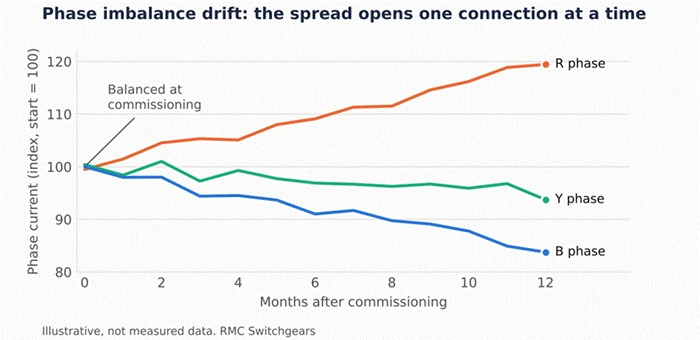
Figure 2. Phase currents drift apart as connections are added. Illustrative, not measured data.
Signal 3: Which way is leakage current moving?
Leakage current is rarely on record, because measuring it needs an instrument that stays in place. A clamp reading on a round gives one number with no history. The direction matters more than any single value: a steady figure and a climbing one are different stories, even when today’s number is the same. A rising trend is a reason to visit that site sooner than the calendar says. It also sits close to the questions in our guide to electrical safety in LT distribution: insulation condition, earthing and moisture.
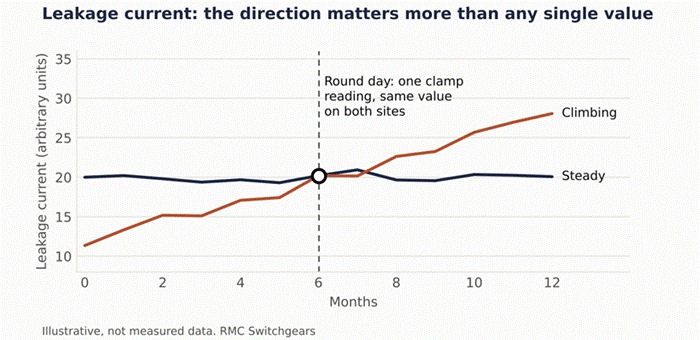
Figure 3. Two sites can show the same value on round day and different trends. Illustrative, not measured data.
Signal 4: How many heating and cooling cycles has it been through?
A temperature reading tells you today’s temperature. It cannot count how many times a joint has heated and cooled. Over thousands of cycles, joints lose clamping force. Heat inside the box adds to it, because an outdoor enclosure in direct sun runs hotter inside than the air around it. Track the daily temperature swing, and how many days the swing is large.
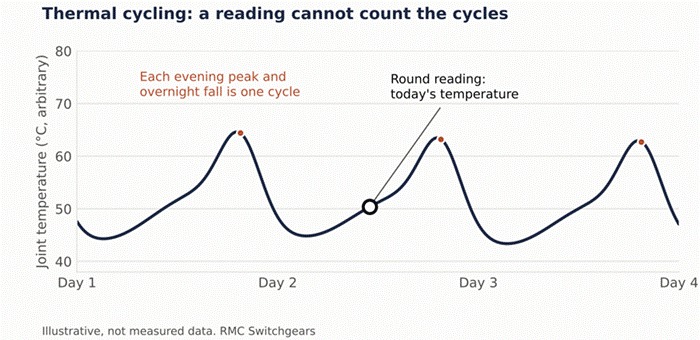
Figure 4. One reading cannot count heating and cooling cycles. Illustrative, not measured data.
How do you scale monitoring to the asset and the people it serves?
Not every transformer needs every signal. Rank sites by what a failure would cost the people on them:
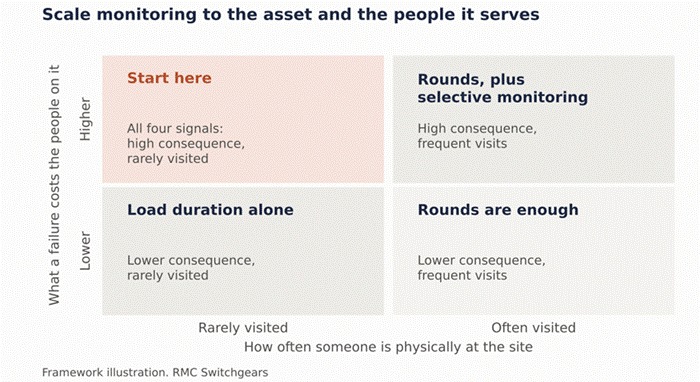
Figure 5. A simple way to rank sites before choosing which signals to monitor.
| Factor | Question to ask |
| Consumers served | How many connections lose supply, and are any critical, such as a hospital or water pumping? |
| Restoration effort | How far is the crew, and how long does a replacement take? |
| Round frequency | How often is anyone physically at the site? |
| Public exposure | Is the unit on a footpath or beside homes? |
High scores on several rows justify all four signals. A low score may justify load duration alone, or nothing. Metering is a separate layer: under RDSS, smart metering has been sanctioned for 52.53 lakh distribution transformers, which records how much energy moved. It does not describe equipment condition. Our RDSS tender guide covers where that line sits in a tender, and our view of where smart metering goes next covers what follows.
What does transformer monitoring not do?
It does not replace rounds, because rounds see what sensors cannot. It does not extend transformer life: an overloaded unit stays overloaded until someone adds capacity, and if your units are undersized, the answer is transformers. Our guide to distribution transformer failure explains the causes. Monitoring changes when you find out. A trend flagged on Tuesday becomes a planned visit. The same problem found at failure becomes an outage.
Declaring our interest
RMC Switchgears makes Pulse Box™ and LT distribution boxes. Pulse Box™ sits at the LT distribution box, monitors leakage current and flags abnormal conditions. Its product page lists continuous monitoring of harmonics, phase imbalance, power factor, temperature and leakage current. It complements rounds, smart meters and protection, and replaces none of them. See how intelligent LT distribution systems fit the wider network.
The short version
Rounds tell you what a transformer looked like when someone arrived. Monitoring tells you what happened while nobody was there. Utilities need both, in proportion to what each site puts at stake.
Where to start
Pick the five transformers whose failure would hurt most. For each, note when someone last stood beside it, and at what hour. The gap between that reading and the evening load is your visibility problem. To assess a site in a structured way, download the LT-Interface Site Checklist: 13 questions to ask before your team calls a distribution transformer site assessed.
Sources
Ministry of Power, Progress on smart meter installation under RDSS, PIB release ID 2222217, 2 February 2026:
About RMC Switchgears
RMC Switchgears Limited, based in Jaipur, develops electrical distribution, enclosure and safety solutions for utilities, EPC contractors and infrastructure customers across India. Its portfolio spans metallic and composite enclosures, FRP safety solutions, LT distribution equipment and intelligent LT-network solutions, including Pulse Box™.
Frequently asked questions
What is distribution transformer monitoring?
It keeps instruments in place at or near a transformer, so load, phase balance, leakage current and temperature are recorded as trends between rounds, not read once at a visit.
What should you monitor on a distribution transformer?
Four signals: time above rating, phase imbalance drift, leakage current trend and thermal cycling. Start with the ones your rounds cannot see.
Does monitoring replace scheduled maintenance?
No. Rounds find physical faults that sensors miss. Monitoring adds the history between visits.
Does monitoring extend transformer life?
No. It changes when you find out, which lets a visit be planned instead of forced.
Is monitoring worth it for every transformer?
Not necessarily. Rank sites by consumers served, restoration effort, round frequency and public exposure, and start where the score is highest.