3,892 of them. Listed causes include violation or neglect of safety measures (967), inadequate maintenance (581) and snapping of conductors (566). An audit exists to catch these failures before they reach a person.
Quick answer
An LT electrical safety audit is a structured inspection of transformers, earthing, feeder pillars, meter boxes and overhead lines, recorded so results can be compared over time. Under CEA’s 2023 regulations, supplier earthing is tested at least once a year on a dry day in the dry season. CEA’s transformer guidelines add quarterly load-balance checks and half-yearly thermal scans.
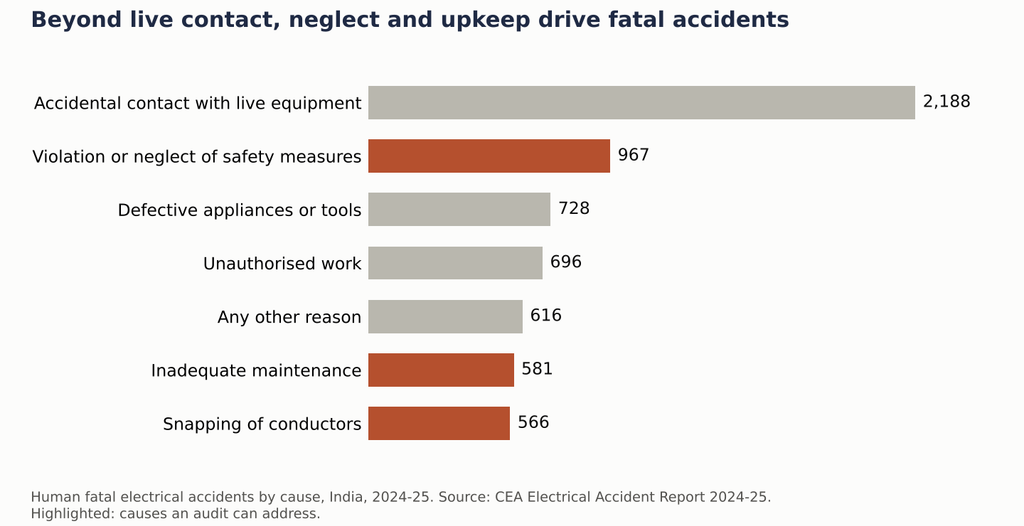
Figure 1. Fatal accidents by cause, 2024-25. Source: CEA Electrical Accident Report 2024-25.
Why do LT networks need their own audit?
The LT network is the part of the grid closest to people. Transformers, pillars, boxes and overhead lines sit at street level, spread across many small assets that different crews look after. No single visit sees them all, and a defect in one of them reaches a consumer or a passer-by directly. Our guides to electrical safety challenges in LT distribution and its hidden risks explain why these defects stay unseen for so long.
What is an LT electrical safety audit?
It is a planned, documented check of the low-tension network, from the transformer to the consumer’s meter. A routine round answers “does it look fine today?” An audit answers “is it safe, and is it getting better or worse?” It uses a fixed checklist, real measurements and written records. This is the same trend-based thinking behind our guide to earthing failure in LT distribution.
What should you inspect?
Start with the parts where a failure puts people at risk. The table shows what to check, how often, and where the interval comes from.
| Area | What to check | How often | Basis |
|---|---|---|---|
| Earthing | Earth resistance, joints, tank and neutral earth connections | Yearly, dry season | CEA Reg. 43(x); CEA transformer guidelines |
| Load balance | Current on all three phases and neutral current | Quarterly | CEA transformer guidelines |
| Temperature | Thermal scan of connections and joints | Half-yearly | CEA transformer guidelines |
| Oil and tank | Oil level, leaks, bushing condition | Half-yearly | CEA transformer guidelines |
| Yard and fence | Vegetation, fence, covers, warning boards | Monthly | Our suggestion |
| LT protection | Fuse size, MCB on the LT side, loose or burnt connections | Quarterly | Our suggestion |
| Feeder pillars and meter boxes | Locks, doors, gaskets, corrosion, cable entries | Quarterly | Our suggestion |
| Overhead LT lines | Sag, damaged insulation, conductor condition, clearance | Half-yearly | Our suggestion |
CEA’s guidelines name improper fuse size and the absence of an MCB on the LT side as causes of transformer failure. They also call for the substation yard to be kept clear of vines and shrubs, and for a covering fence against animal contact. They set no interval for fences or feeder pillars, so those rows are our suggestion. Adjust them to your own site risk.
How often should you audit?
Use layers, not one date. Frequent light checks catch fast-changing conditions. Rarer, deeper tests catch slow ones.
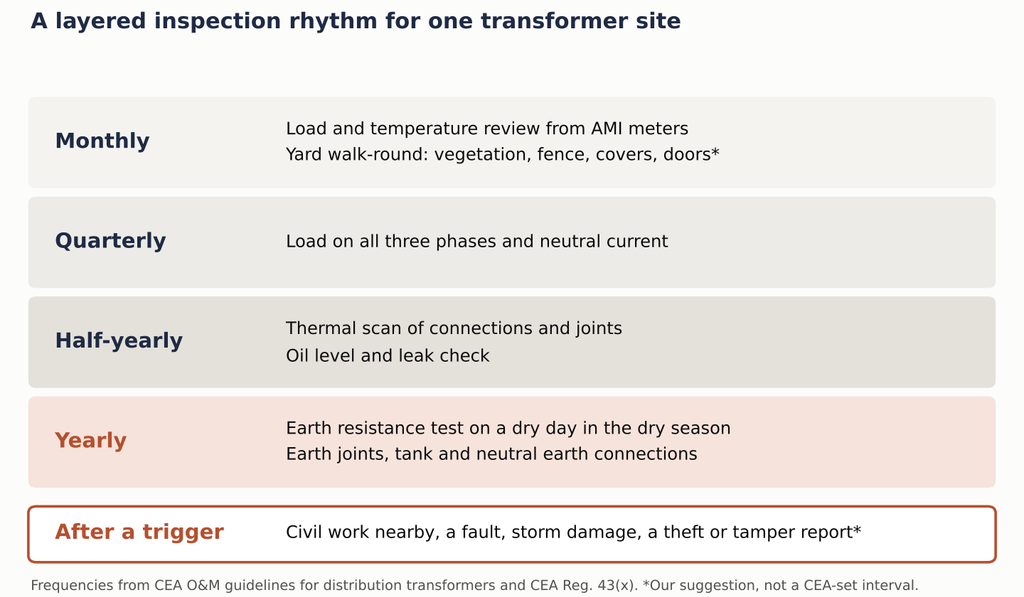
Figure 2. Inspection frequency for one transformer site. Starred items are our suggestion.
- Monthly: review load and temperature from smart meter data, and walk the yard.
- Quarterly: check phase load, neutral current, LT fuses and boxes.
- Half-yearly: thermal scan and oil check.
- Yearly: test earth resistance in the dry season, when soil is driest.
- After a trigger: road or drainage work nearby, a fault, storm damage or a theft report.
CEA’s transformer guidelines give an earth resistance target of below 1 ohm. Read each result against the last one, not only against that target. A rising series is a reason to act even while it passes.
Which sites should you audit first?
Rank sites by what a failure would cost the people nearby. Count the connections served, how close homes, schools or footpaths are, how long since the last test, and whether earth readings are rising. A site that scores high on several of these goes to the front of the queue. The same logic applies when you investigate transformer failures: start where the consequence is greatest.
How do you run an audit, step by step?
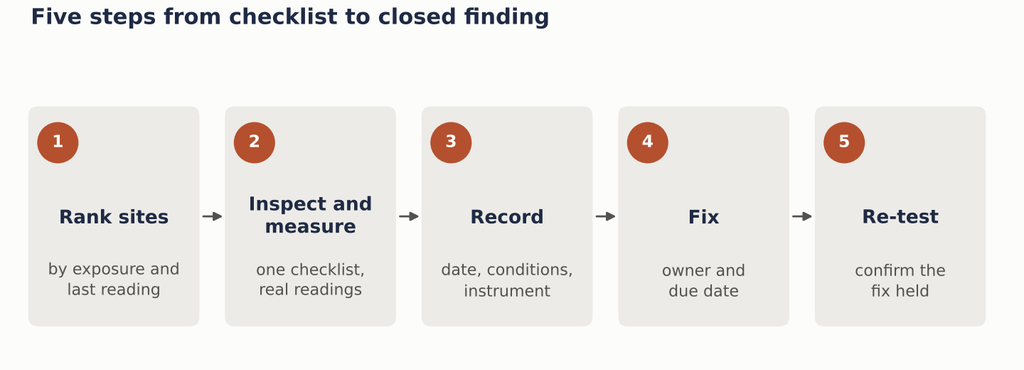
Figure 3. The audit cycle.
- Rank your sites. Put transformers near homes, footpaths, schools and markets first, and those with the oldest or highest earth readings.
- Use one checklist. The same questions at every site make results comparable. Our LT-Interface Site Checklist is a starting point.
- Measure, do not only look. Earth resistance, phase currents and temperature need instruments.
- Record every result. Note the date, soil condition, instrument and any nearby work. CEA Reg. 43(xi) requires a record of every earth test.
- Close each finding. Give every defect an owner and a due date, then re-test to confirm the fix held.
What are the most common audit mistakes?
- Auditing only on a convenient day. Conditions change with load and season, so one visit can mislead.
- Testing earth in the wrong season. A reading taken just after the monsoon is close to a best case, which is why CEA specifies the dry season.
- Treating pass or fail as the end. A result that passes but has risen every year still needs attention.
- Keeping no baseline. Without earlier readings, nobody can say whether a site is improving.
- Finding defects and not closing them. A finding with no owner and no date stays open.
What do audits miss?
An audit is a snapshot. A transformer can pass in March and be overloaded every evening by June. Monitoring fills the gap between visits: our post on distribution transformer monitoring explains which four signals build up between rounds. Pulse Box™ monitors leakage current and flags abnormal conditions. It does not measure earth resistance and does not replace the audit, the earth test or any protective device.
Where physical safeguards fit
Audits find hazards. Physical safeguards limit what a hazard can do. See our notes on transformer centre safety mistakes and FRP fencing, and on why outdoor enclosures need to be weatherproof.
Sources
CEA, Electrical Accident Report 2024-25
CEA, Guidelines for Operation and Maintenance of Distribution Transformers
CEA (Measures relating to Safety and Electric Supply) Regulations, 2023
About RMC Switchgears
RMC Switchgears Limited, based in Jaipur, develops electrical distribution, enclosure and safety solutions for utilities, EPC contractors and infrastructure customers across India. Its portfolio spans metallic and composite enclosures, FRP safety solutions, LT distribution equipment and intelligent LT-network solutions, including Pulse Box™.
Frequently asked questions
How often should an LT network be audited?
Use layers: monthly load review and yard walk-round, quarterly load-balance checks, half-yearly thermal scans, and a yearly dry-season earth test. Add a check after any fault, storm or nearby civil work.
What does CEA require for earth testing?
CEA’s 2023 safety regulations require supplier earthing to be tested for resistance at least once a year, on a dry day in the dry season, and a record of every test to be kept.
What should be checked on a distribution transformer?
Earthing, oil level and leaks, load on each phase, neutral current, temperature at connections, LT fuses and MCBs, and the condition of the yard and fence.
Who should carry out an electrical safety audit?
Trained, authorised staff or a qualified third party, using calibrated instruments. Follow your utility’s own safety procedures when working near live equipment.
What records should an audit keep?
The date, site, readings, instrument used, soil and weather conditions, nearby work, defects found, the owner assigned and the date each was closed.
The short version
Audit in layers, measure rather than look, and keep every result as a series. Rank sites by who is exposed, close each finding with an owner and a date, and re-test. Monitoring and physical safeguards then cover what happens between audits.