Quick Answer:
Intelligent distribution systems reduce maintenance costs by turning unplanned, reactive repairs into planned, condition-based work. Monitoring systems can track relevant electrical and asset-condition signals, helping crews identify developing problems and address them before they become costly failures.
Key Takeaways
- Reactive maintenance is usually the most expensive kind, because emergency work costs more than planned work.
- The savings come mainly from avoided costs: fewer emergency callouts, fewer premature replacements and fewer wasted routine visits.
- Predictive (condition-based) maintenance depends on measuring the right signals, not on collecting more data.
- Monitoring does not help if the crew or spare-parts capacity to act on alerts does not exist.
The Three Kinds of Maintenance, and What Each One Costs
Most distribution utilities run a mix of three approaches. The cost difference between them explains why intelligent systems matter.
Reactive maintenance: the most expensive kind by default
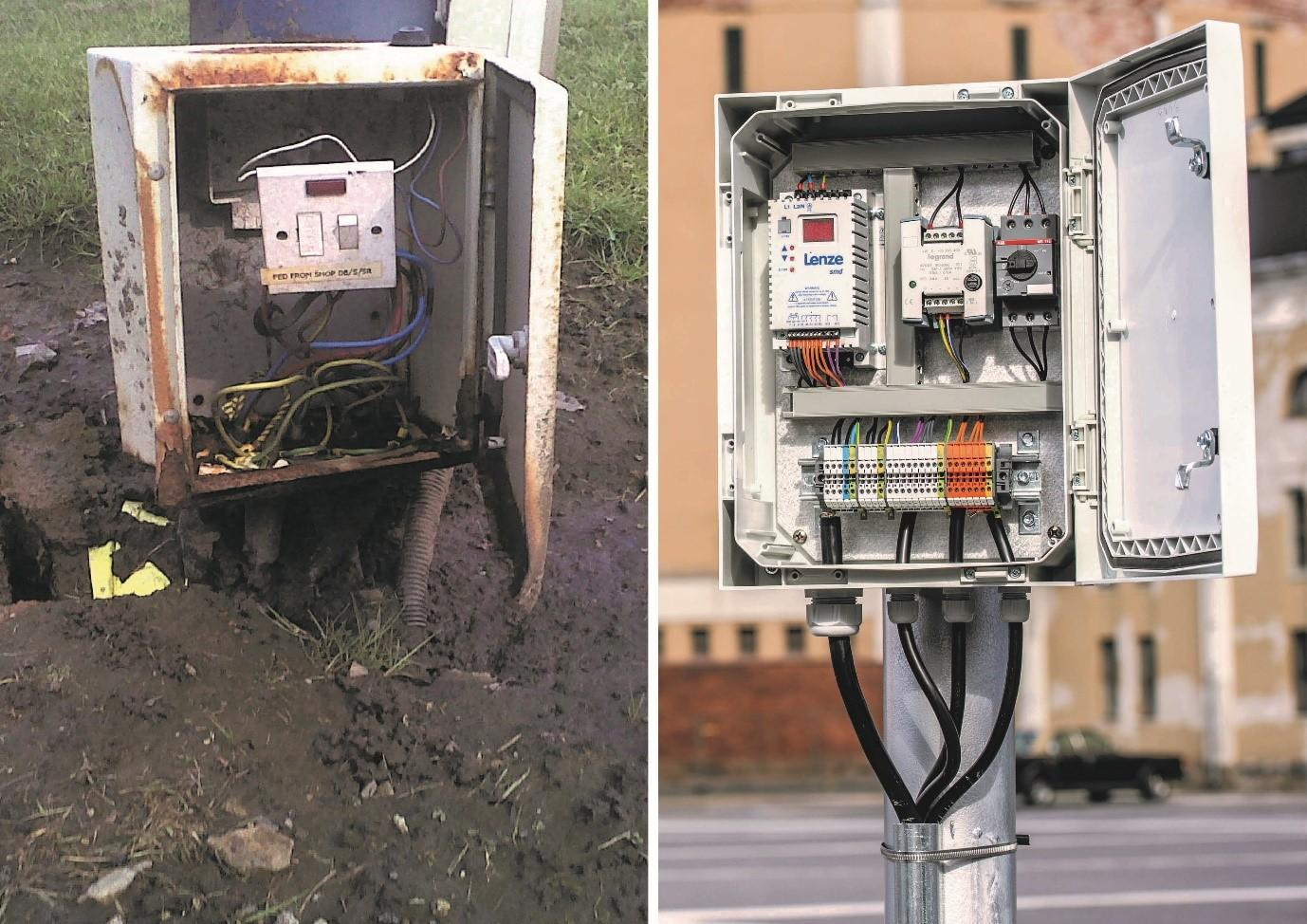
Reactive maintenance means fixing an asset after it fails. The visible cost is the repair. The hidden costs are larger: emergency crew mobilisation, overtime, rushed spare procurement, consumer complaints and lost supply hours. A failed asset can also damage the equipment around it, which turns one repair into several.
Preventive maintenance: scheduled, but often wasteful
Preventive maintenance means servicing assets on a fixed calendar, whether or not they need it. It reduces surprise failures, but it treats a lightly loaded feeder and a heavily overloaded one identically. Crews spend time on healthy assets, while a deteriorating one can still fail between visits.
Predictive maintenance: acting on actual asset condition
Predictive, or condition-based, maintenance means intervening when measured data shows an asset is drifting toward failure. A transformer running hot under sustained overload gets attention first. A lightly loaded one is left alone. This is the approach intelligent distribution systems make possible.
| Approach | Trigger | Main cost risk |
|---|---|---|
| Reactive | Failure | Emergency repair, outage, collateral damage |
| Preventive | Calendar | Unneeded visits, missed mid-cycle failures |
| Predictive | Measured condition | Setup cost, need for reliable data |
Where the Real Savings Come From
The savings from intelligent systems are mostly avoided costs, not new revenue. Three sources matter most.
Fewer emergency callouts. An early alert about rising temperature or persistent overload lets a crew visit in daylight, with the right parts, on a planned schedule. The same job done at night after a breakdown costs more in labour, logistics and consumer impact.
Avoided premature replacement. Without data, utilities often replace assets “to be safe.” Condition data shows which assets still have useful life and which are close to failure, so replacement budgets go where they are needed.
Smarter routine visits. Inspection rounds can focus on assets that data flags as stressed. This frees crew hours for repairs that matter, instead of checking assets that are fine.
The Cost Categories a Maintenance Budget Should Separate
Many maintenance budgets lump everything into one line, which hides where money goes. Separating the categories makes savings measurable.
| Cost category | Reactive baseline | What intelligence changes |
|---|---|---|
| Emergency crew callouts | Frequent, often after hours | Fewer, mostly planned |
| Spare parts and rush procurement | Bought under time pressure | Ordered ahead of need |
| Premature replacement | Common, precautionary | Based on measured condition |
| Routine inspection rounds | Fixed schedule for all assets | Prioritised by asset stress |
| Outage-related losses | Full exposure | Reduced by early intervention |
Tracking these lines separately, before and after deployment, is what turns “we think it helps” into a number a finance team can accept.
What Intelligent Systems Need to Measure
Intelligence only reduces costs if it measures signals that predict failure. On the LT side of the network, four matter most:
- Load: sustained overload is a leading cause of thermal stress and insulation ageing.
- Phase balance: persistent imbalance overheats conductors and connections and points to network or connection problems.
- Temperature: rising temperature at terminals, enclosures or transformers is an early sign of loose connections and overload.
A system tracking these signals at the LT layer can flag problems that were previously invisible until an outage. A system that only reports “supply on/off” cannot support predictive maintenance, however advanced its dashboard looks.
For a deeper look at how monitoring applies to transformer failures specifically, see our post on distribution transformer failure and where monitoring helps.
The Honest Limits: When Monitoring Won’t Reduce Costs
Intelligent systems are not a fix for every network. Costs will not fall meaningfully when:
- Crew capacity is the bottleneck. An alert is only useful if someone can act on it. If crews are already stretched, more alerts create a longer backlog, not lower costs.
- Data quality is poor. Miscalibrated sensors or missing asset records lead to false alarms, and teams soon stop trusting them.
- Spares and procurement are slow. Early warning does not help if the part takes months to arrive.
- The network is very small or low-risk. For a handful of lightly loaded assets, simple periodic inspection may cost less than a monitoring system.
Being clear about these limits leads to better decisions. Utilities that fix response capacity first, then add monitoring, usually see better returns than those that buy monitoring alone.
Frequently Asked Questions
How much can predictive maintenance reduce costs compared to reactive maintenance?
Savings vary widely by network, asset age and how expensive emergencies currently are. Reactive work is almost always costlier per repair, so the gain comes from shifting failures into planned work. A pilot on a defined set of assets, with the cost categories above tracked separately, gives the most reliable estimate.
What is the difference between preventive and predictive maintenance?
Preventive maintenance follows a fixed calendar. Predictive maintenance follows measured asset condition. Preventive asks “is it time?” while predictive asks “does this asset need attention now?”
Does intelligent monitoring reduce maintenance costs immediately?
Not usually. Costs often rise slightly at first because of installation and setup. Savings typically become measurable after baseline data has been established and teams begin acting consistently on alerts. The timeframe depends on the network, asset condition, and maintenance practices.
What data does a DISCOM need to shift from reactive to predictive maintenance?
The monitoring requirements depend on the asset type, operating conditions, and likely failure modes. Depending on the application, relevant signals may include load, phase balance, temperature, leakage current, harmonics, power factor, or other condition indicators.
Is predictive maintenance worth it for smaller distribution networks?
Sometimes. Where failures are rare and consequences are low, periodic inspection may be enough. It pays off most where assets are heavily loaded, failures are frequent or outages carry high costs.
Where to Start
Start small. Choose a limited set of assets with a history of frequent failures or high repair costs. Separate their maintenance costs into the categories above, install monitoring for the key LT signals, and compare results over a full season. If the savings are visible, expand. If crew or spare-parts capacity turns out to be the real constraint, fix that first.
If you are evaluating intelligent LT distribution for your network, RMC Switchgears can help you scope a pilot.