A distribution transformer rarely fails without warning. It fails at the end of a long, mostly visible degradation — sustained overload, phase imbalance, moisture ingress, deteriorating oil. The reason failures feel sudden is that the last step usually completes at night, on a feeder nobody is watching. The first person to notice is a consumer without power.
The useful question isn’t “why did it fail.” It’s “how long was it failing before anyone knew.”
Why This Is a Different Problem in India
A distribution transformer is designed for a 25-30 year service life. Very few Indian DTs get there.
Industry commentary on Indian distribution puts DT failure rates for state utilities at roughly 12-15% a year, against a global norm nearer 1-2%. That figure circulates widely, and it’s directionally consistent with what any field engineer will tell you. But it’s worth being precise about where it comes from: sector commentary, not a published national statistic. The Central Electricity Authority publishes electrical accident data. PFC publishes utility performance data. But a clean, audited national DT failure rate is one of the genuinely missing numbers in Indian distribution.
You cannot manage a failure rate nobody measures consistently.
What isn’t in dispute is the shape of the problem. DTs in India carry loads their nameplate never anticipated, in ambient conditions at the top of their design envelope, on networks where the LT side downstream is largely uninstrumented.
What Actually Kills a Distribution Transformer
Failures get recorded as “burnt” or “damaged.” That’s an outcome, not a cause. In practice, four mechanisms do most of the work — and they compound.
1. Sustained Overload, Not Peak Overload
A DT tolerates short overloads comfortably. What degrades it is running above rated current for hours, repeatedly, across seasons.
The damage is thermal and cumulative. Winding insulation ages as a function of temperature and time — every sustained excursion above design temperature spends insulation life that never comes back. A transformer run 20% over its rating through three summers isn’t a healthy transformer that happens to be busy. It’s a transformer with much of its life already consumed.
This is why load growth is dangerous even when nothing trips. Nothing looks wrong. The asset is quietly being spent.
2. Phase Imbalance
Single-phase loads distributed unevenly across three phases produce neutral current, additional heating, and localised hot spots in the winding.
Imbalance is common on Indian LT networks because connections get added where the demand is, not where load balance would prefer. And it’s close to invisible without LT-side measurement — a DT-level meter reporting total energy will show a perfectly reasonable number while one phase runs hot.
3. Moisture and Oil Deterioration
Oil is both coolant and insulation. Moisture ingress degrades its dielectric strength, and the entry routes are unglamorous: breather silica gel long past saturation, a perished gasket, a conservator seal, a bushing.
Once dielectric strength falls, the margin protecting the winding falls with it. The failure that eventually occurs will be recorded as a winding failure. Its origin was a breather nobody changed.
4. Downstream Faults Arriving Upstream
An LT-side fault — a failed joint, a tracking insulator, an unbalanced load surge — sends its fault current back through the transformer. Protection may clear it, but each event is a mechanical and thermal shock to the winding.
A DT on a feeder with a deteriorating LT network is absorbing repeated punishment from a problem that isn’t in the transformer at all.
The Window Before Failure — The Part Worth Understanding
Here’s the thing that changes how you think about this.
Each of those four mechanisms is progressive. Sustained overload has a duration. Phase imbalance has a pattern. Oil degrades over months. LT faults recur before they become permanent.
The degradation is almost always present for weeks. The failure takes seconds. And the gap between them is where every avoidable outage lives.

Weeks of visible degradation compressed into a failure that reads as sudden
So why is it missed so consistently? Three practical reasons, none of them anyone’s fault:
- The peak that does the damage is not the peak anyone is present for. Evening and night loading on a residential feeder is where sustained overload lives. Daytime inspection rounds see the network at its most comfortable.
- Monthly reads average the problem away. A monthly consumption figure can’t show a feeder that ran 20% over rating for four hours a night. The information is destroyed by the sampling interval, not missing from the network.
- Nothing on the LT side reports. Smart metering under RDSS has put substantial measurement at the consumer end and at DT level. Very little of it describes the condition of the network between the two.
That’s the honest gap. Not a lack of concern, and not a lack of competence. A measurement interval and a measurement location that were never designed to catch a slow failure.
What the Regulations Actually Require Once One Fails
This part gets discussed less than it should, and it’s where the cost becomes concrete.
Maharashtra’s electricity regulator (MERC) publishes a clear standard under its Standards of Performance regulations: distribution transformer and associated switchgear failure must be restored within 18 hours in urban areas and 48 hours in rural areas. Other states apply their own variants — for example, Telangana’s TSERC sets 24 hours for cities and towns, 48 hours for rural areas. These figures vary by state; confirm your operating state’s specific SOP before citing a number in a client-facing document.
| State / Standard | Urban / Cities | Rural |
|---|---|---|
| Maharashtra (MERC) | 18 hours | 48 hours |
| Telangana (TSERC) | 24 hours | 48 hours |
A rural DT failure can legally take up to two days to restore. That’s not a utility failing its obligations. That is the obligation. For the consumers on that transformer, it’s still two days.
Second, the clock is a restoration clock, not a detection clock. It starts when the utility knows. Every hour between the failure and the report is an hour that doesn’t appear in any compliance statistic — and on a rural feeder at night, that can be a long time.
Repair, Replace, and What the Asset Actually Costs
Rather than quote specific rupee figures without a verifiable current source, it’s more useful to think in relative terms: cost scales roughly with capacity, and the unit price is rarely the real cost.
| Rating Class | Relative Cost vs. 25 kVA Unit | What Drives It |
|---|---|---|
| 25 kVA | Baseline | Smallest common rural/residential rating |
| 100 kVA | ~2-2.5x baseline | Standard urban/semi-urban distribution |
| 250 kVA | ~4-4.5x baseline | Larger commercial/mixed-load feeders |
| 500 kVA | ~7x baseline | Industrial and dense urban feeders |
| 1000 kVA | ~10-11x baseline | Heavy industrial / bulk supply points |
The unit cost is rarely the real cost. Replacement carries transport, crew, crane where required, civil work, and the outage itself. A DT that fails at year eight instead of year twenty-five hasn’t cost one replacement — it’s committed the utility to two extra replacement cycles across the asset’s intended life.
We are deliberately not putting a rupee figure on what that adds up to for a DISCOM. It depends on network age, load growth, terrain and crew availability — anyone quoting a confident national number for it is guessing.
Where Monitoring Helps, and Where It Does Not
This is the part where a manufacturer is supposed to tell you the answer is more equipment. The honest version is narrower than that.
Monitoring does not stop a transformer failing. It does not reduce load, correct a phase imbalance, or change the oil. What it does is close the gap between degradation starting and somebody knowing.
So there are cases where instrumentation is the wrong purchase:
- If your DTs are failing because they’re genuinely undersized for present load, buy transformers. Visibility will tell you precisely and repeatedly that the asset is overloaded. You already know.
- If failures cluster on one contractor’s installations or one batch, that’s a quality and workmanship problem. Data will confirm it faster; it won’t fix it.
- If maintenance rounds aren’t happening at all, the constraint is crew, not information.
Where visibility does earn its place is the middle case, which is also the common one: a network that’s broadly adequately specified, ageing unevenly, with a handful of transformers degrading faster than the rest and no way to tell which ones. That’s a search problem, and search problems respond well to measurement.
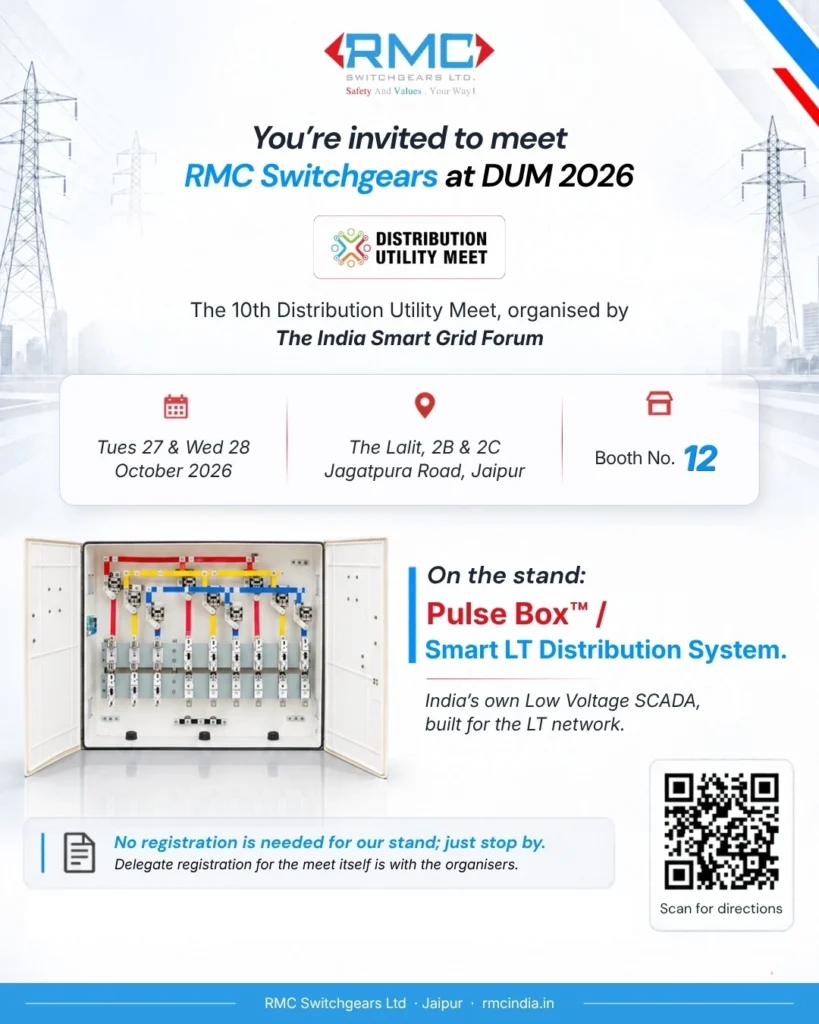
Pulse Box™ sits on that interface — the LT side between the DT and the consumer — because that’s the part of the network with the least instrumentation and the most information about how the transformer above it is actually being treated. It complements smart metering rather than replacing it: the meter answers how much, the LT layer answers under what conditions.
Frequently Asked Questions
What is the main cause of distribution transformer failure in India?
No single cause dominates. In practice four mechanisms compound: sustained overload above rated current, phase imbalance producing localised heating, moisture ingress degrading oil dielectric strength, and repeated fault current arriving from a deteriorating LT network. The recorded cause is usually winding failure, which is the outcome of one or more of these rather than a cause in itself.
How long does a distribution transformer last in India?
Distribution transformers are designed for roughly 25-30 years. Indian service life is widely reported to fall well short of that, though a clean audited national failure rate is one of the missing numbers in Indian distribution data.
Can distribution transformer failure be predicted?
Not predicted in the sense of a date. But the degradation that precedes failure — sustained overload, growing phase imbalance, deteriorating oil condition — is measurable and usually present for weeks. The practical goal is detection early enough to intervene, not prediction.
How long does a utility have to restore supply after a DT fails?
This varies by state regulator. Under Maharashtra’s MERC Standards of Performance, distribution transformer failure must be restored within 18 hours in urban areas and 48 hours in rural areas. Other states set different figures — always confirm the specific SOP for the state in question rather than assuming a single national standard.
Does smart metering solve distribution transformer failure?
It addresses a different question. Smart metering measures energy — how much was consumed and where billing and supply disagree. It doesn’t describe the condition of the network between the transformer and the meter: voltage quality at the feeder, phase balance, or the LT-side faults that shorten transformer life.
Is monitoring worth it if we already know our transformers are overloaded?
Often not. If the network is chronically undersized for present load, the constraint is capacity and the answer is transformers. Monitoring earns its place where the network is broadly adequate but ageing unevenly, and you can’t tell which units are degrading fastest.
Where to Start
Before specifying anything, do one exercise. Take your last twelve months of DT failures and, for each, establish two timestamps: when the failure was reported, and the last date anyone was physically at that transformer.
The gap between those two numbers is the size of your visibility problem, and it’s usually larger than expected. It also tells you something no vendor can: whether your failures are a capacity problem, a maintenance problem, or a detection problem. Those three have different answers, and only one of them is solved by more measurement.
RMC Switchgears has built enclosures and distribution equipment for Indian grid conditions since 1994, supplying DISCOMs, OEMs and EPC contractors nationwide from Jaipur.