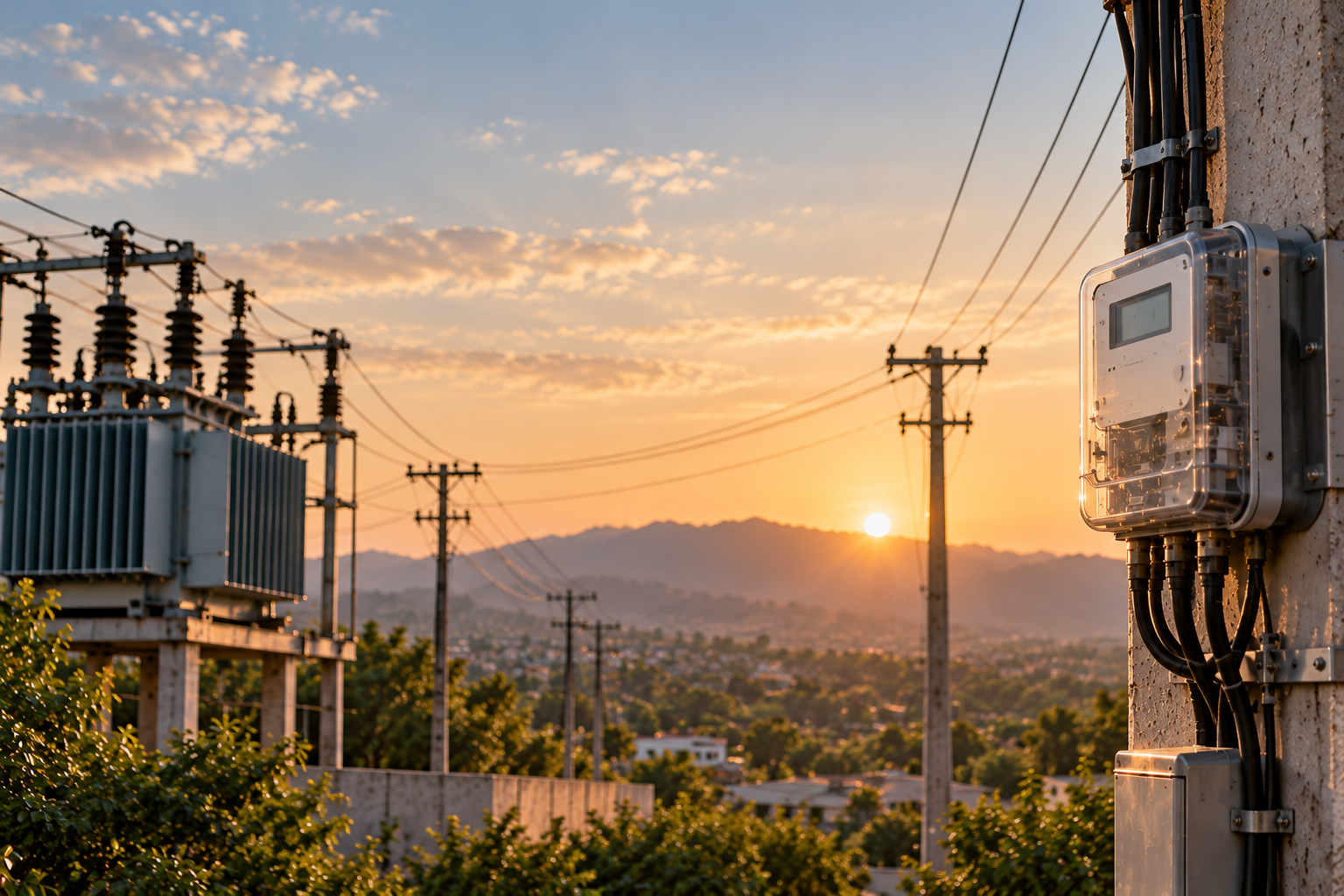
An earthing system can pass this year’s test and still be worse than it was last year. The reading is correct. What one reading cannot show is the direction.
Quick answer
Earthing in LT distribution degrades between tests through four causes: electrode corrosion, seasonal change in soil resistivity, loose or oxidised joints, and nearby civil work that disturbs or cuts the earth conductor. CEA’s 2023 regulations require supplier earthing to be tested at least once a year, on a dry day in the dry season, with a record of every test kept.
Key takeaways
- The rule already assumes earthing degrades. The harder part is reading the results as a trend.
- A degraded earthing system may show no obvious symptoms during normal operation. Only measurement reveals it.
- Soil moisture changes earth resistance sharply, so test timing and conditions belong in the record.
- Monitoring leakage current can prompt a visit. It does not measure earth resistance and does not replace the test.
Key terms
| Term | Meaning |
|---|---|
| Earth electrode | The rod, plate or conductor buried in soil that connects the system to earth. |
| Earth resistance | How much the electrode and the soil around it resist current flowing to earth, measured in ohms. |
| Soil resistivity | How strongly the soil resists current, measured in ohm-metres or ohm-cm. It changes with moisture and temperature. |
| Fall-of-potential test | A standard way to measure electrode resistance using an earth tester and two auxiliary probes. |
| Earth conductor | The cable or strip joining equipment to the electrode. |
What is earthing failure in LT distribution?
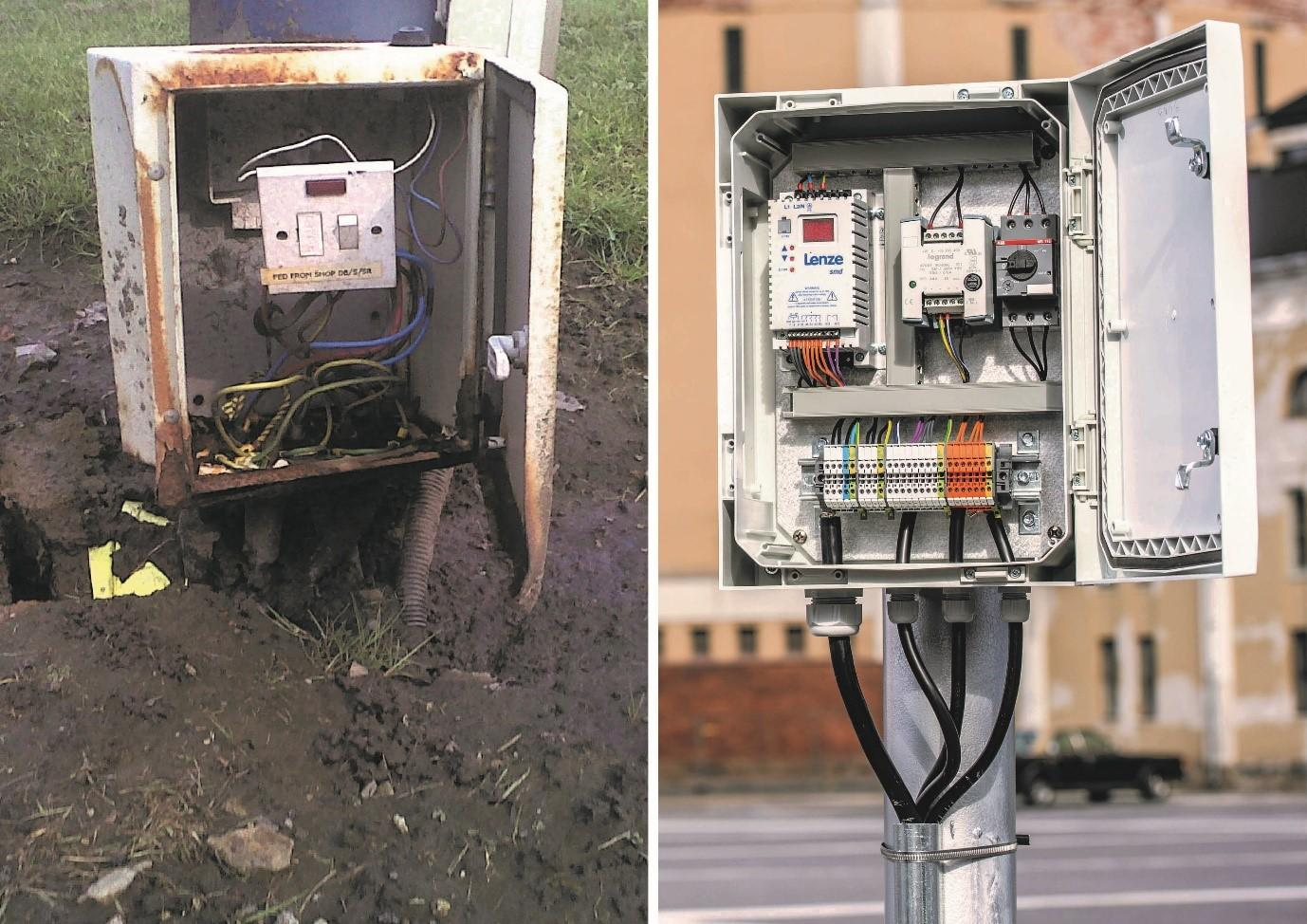
Earthing failure means the path to earth no longer behaves as designed. Resistance has risen, a joint has opened, or the conductor is cut. On an LT network the earth carries fault current away from transformers, distribution boxes and the people who touch them. If the path degrades, a fault can leave metalwork at a dangerous potential. This is part of the wider set of risks in our guide to electrical safety in LT distribution and in the hidden risks of LT distribution.
What degrades earthing between tests?
Four things, and none of them is visible from the surface.
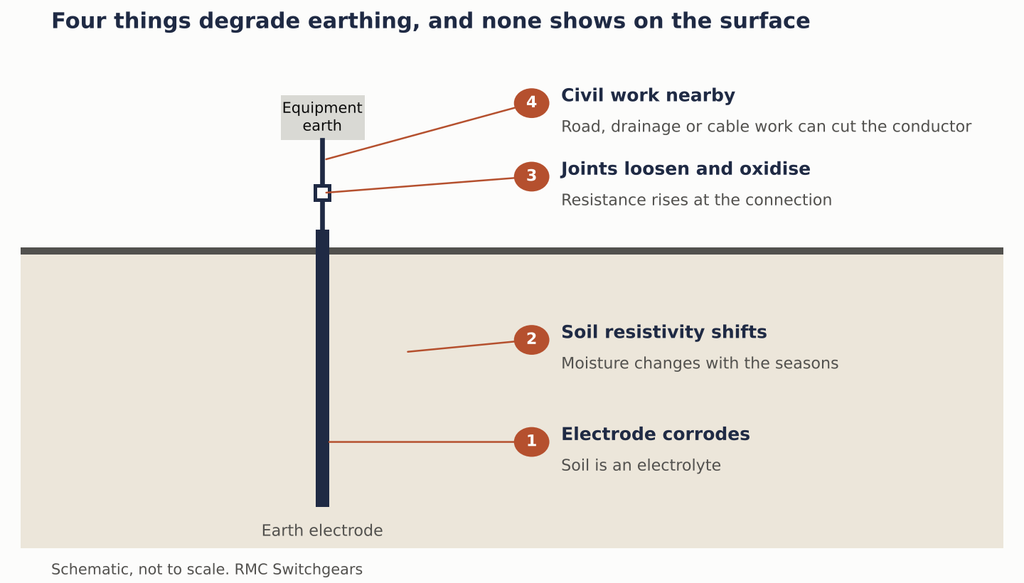
Figure 1. Four causes of earthing degradation. Schematic, not to scale.
1. The electrode corrodes
Soil is an electrolyte, so a buried electrode is always in a corrosive environment. The IET’s guidance on inspecting and testing earth electrodes notes that an existing electrode “may well have corroded to some degree”, and that its construction and burial details are often unknown. The only way to know its condition is to measure it.
2. Soil resistivity shifts with the seasons
Moisture is the biggest driver. In the AEMC grounding workbook’s table for sandy loam topsoil, resistivity falls from about 250,000 ohm-cm at 2.5% moisture to 4,200 ohm-cm at 30%, roughly sixty times lower. The workbook states that “the resistance of any grounding system will vary throughout the different seasons of the year”. It also notes that soil deeper down is more stable, because moisture and temperature change less there.
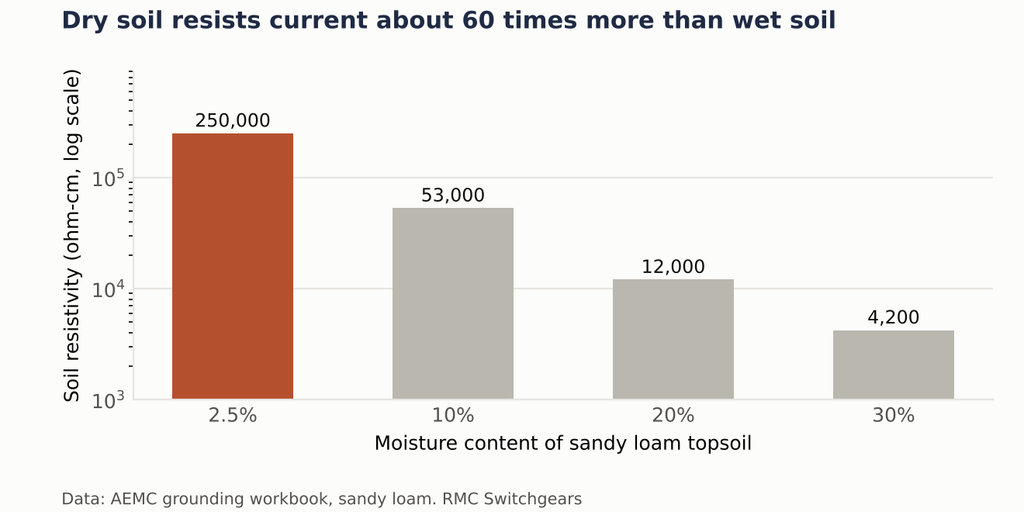
Figure 3. Soil resistivity falls steeply as moisture rises. Source: AEMC grounding workbook, sandy loam.
This is why test timing matters. A reading taken just after the monsoon, when the ground is wet, is close to a best case for that site.
3. Joints loosen and oxidise
Every connection between the electrode, the earth conductor and the equipment is a place where resistance can build up. Joints loosen with vibration and heating, and oxidise where moisture reaches them. A joint can fail while the electrode itself is sound, so the reading at the electrode alone can miss it. Inspect the joints, as well as measuring the electrode.
4. Civil work nearby disturbs or cuts the earth conductor
Road, drainage and cable work happen close to LT equipment, and a buried conductor is easy to cut without anyone noticing. A public alert from New Zealand shows the consequence. In June 2025, earth conductors were cut and stolen from two pole-mounted 11 kV transformers. The utility found the thefts while investigating high loop impedance readings, and warned that an incomplete earthing system could leave a hazard at the pole. The cause there was theft rather than road work, but the lesson is the same: a missing earth conductor is invisible from the ground.
What do CEA regulations require?
The CEA (Measures relating to Safety and Electric Supply) Regulations, 2023 set the minimum for suppliers. Under Regulation 43(x), supplier earthing is tested for resistance at least once a year, on a dry day in the dry season. Under Regulation 43(xi), a record of every earth test is kept. The annual rule is a floor. It leaves open how to read one result against the last.
How do you read earth test results as a trend?
Compare each result with the previous one at the same site, not only with a limit. The chart below uses illustrative readings. Both sites test within the same range in 2023. By 2026, Site A has risen from 1.8 to 6.0 ohms and Site B has not moved.
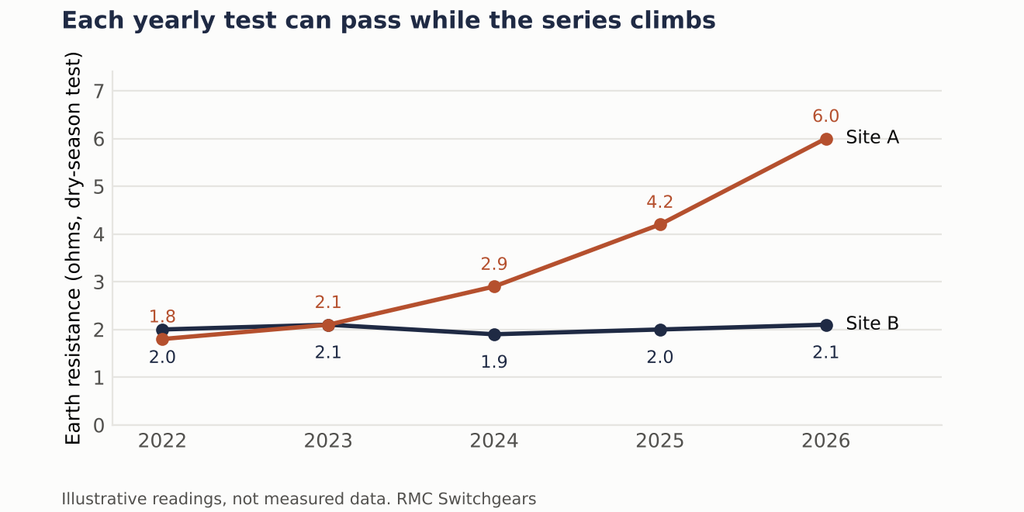
Figure 2. Two sites, five dry-season readings each. Illustrative, not measured data.
| Year | Site A (ohms) | Change on previous test | Site B (ohms) |
|---|---|---|---|
| 2022 | 1.8 | – | 2.0 |
| 2023 | 2.1 | +17% | 2.1 |
| 2024 | 2.9 | +38% | 1.9 |
| 2025 | 4.2 | +45% | 2.0 |
| 2026 | 6.0 | +43% | 2.1 |
A single reading would have rated Site A acceptable for years. The series shows it deteriorating every year. To make results comparable, record these with each test:
- Date and season: so a dry-season reading is compared with a dry-season reading.
- Soil conditions: dry, damp or recently rained on.
- Instrument and method: the same earth tester and test method each time.
- Nearby work: any road, drainage or cable work since the last test.
The AEMC workbook’s own test form records the same kind of detail: temperature, soil type, moisture, instrument, date and location.
Which sites justify testing more often than once a year?
The annual test is a minimum. In our view, four situations justify going sooner:
- Straight after civil work nearby. Do not wait for the annual date.
- Where the last readings are rising. A trend like Site A’s is a reason to retest and inspect.
- Where the public is close. A unit on a footpath or beside homes puts more people on the consequence.
- Where the soil dries hard in the dry season. The dry-season reading is the one that matters most.
The same ranking logic applies to transformer sites generally. Our guide to distribution transformer failure covers what else builds up between visits, and our note on outdoor enclosures in Indian conditions covers the box around the equipment.
What can monitoring do, and what can it not do?
Be plain about the equipment. Pulse Box™ monitors leakage current and flags abnormal conditions. It does not measure earth resistance: an earth tester does. A change in leakage between tests is a reason to investigate. It does not replace the test or any protective device. See how intelligent LT distribution systems fit alongside rounds, protection and metering.
Frequently asked questions
How often should earthing be tested in India?
Under CEA’s 2023 safety regulations, supplier earthing is tested for resistance at least once a year, on a dry day in the dry season (Regulation 43(x)). Some sites justify testing sooner, such as straight after civil work nearby.
Why is earthing tested in the dry season?
Wet soil conducts better, so a reading taken just after the monsoon is close to a best case. A dry-season test shows the site under the more demanding condition.
What causes earthing failure in LT distribution?
Four things: electrode corrosion, seasonal change in soil resistivity, joints that loosen and oxidise, and nearby road, drainage or cable work that disturbs or cuts the earth conductor.
How do you know if earthing has degraded?
By measuring it. A degraded earthing system may show no obvious symptoms during normal operation. An earth tester gives the resistance, and comparing it with earlier readings shows the direction.
Does earth resistance change with the seasons?
Yes. Moisture and temperature change through the year, and soil resistivity follows. The AEMC workbook states that the resistance of any grounding system varies through the seasons.
What records should be kept of earth tests?
CEA Regulation 43(xi) requires a record of every earth test. Useful practice is to keep the date, the reading, soil conditions, the instrument used and any nearby work, so readings can be read as a series.
Can a monitoring device replace an earth test?
No. Leakage current monitoring can flag abnormal conditions and prompt an investigation, but it does not measure earth resistance and does not replace the test or any protective device.
The short version
Earthing degrades between tests, and a single reading cannot show it. Keep every result as a series, with its date and soil conditions, test in the dry season, and test again after any civil work nearby. Use the trend to decide which sites to visit first.
Where to start
Pull the last three earth test records for your ten most exposed LT sites. Note which readings are rising, and which have no recorded soil conditions. Those sites get the next visit. For a structured walk-through, use the LT-Interface Site Checklist. Our overview of how RDSS is changing distribution infrastructure covers the wider programme these sites sit in.
Sources
Central Electricity Authority, Measures relating to Safety and Electric Supply Regulations, 2023 (Reg. 43(x), 43(xi))
IET, Inspection and testing of earth electrodes
AEMC, grounding workbook (soil moisture, temperature and seasonal variation)
Electricity Engineers’ Association NZ, Earths stolen from SWER transformers (alert 51/2025)
About RMC Switchgears
RMC Switchgears Limited, based in Jaipur, develops electrical distribution, enclosure and safety solutions for utilities, EPC contractors and infrastructure customers across India. Its portfolio spans metallic and composite enclosures, FRP safety solutions, LT distribution equipment and intelligent LT-network solutions, including Pulse Box™.