Quick Answer
Solar sites carry bidirectional power flow and variable generation that standard LT distribution boxes weren’t designed to monitor. A smart LT distribution box can provide supplementary monitoring and operational visibility at the LT distribution level, helping EPC contractors identify potential issues and manage post-commissioning operations. The approved bidirectional net meter remains responsible for measuring import and export energy for billing purposes — not just the DISCOM’s grid.
Key Takeaways
- Solar sites may experience bidirectional power flow, requiring appropriate monitoring and metering arrangements.
- “Smart” in this context means real-time monitoring, remote diagnostics, and fault detection — not just a digital meter bolted onto an old enclosure.
- For EPC contractors, smart LT distribution boxes can help improve operational visibility, potentially reducing diagnostic site visits and helping manage warranty-related issues.
- Net-metering billing relies on approved bidirectional metering for import and export energy measurement. Smart LT distribution boxes can provide supplementary monitoring at the LT distribution level.
- Weatherproofing matters more on solar sites because rooftop and ground-mount installations sit in harsher, more exposed conditions than typical LT network points.
What Makes Solar Projects Different From Standard LT Distribution
A conventional LT distribution network moves power one way: from the grid, through the transformer, to the consumer. Every distribution box on that network was designed around that single direction of flow.
A solar site breaks that assumption. Power now moves both ways — generation flows out to the grid or to the load, and grid supply flows in when generation falls short. Add net metering, and the site needs to track import and export separately, not just total throughput.
Generation itself is also inherently variable — cloud cover, time of day, and seasonal angle all change output within the same hour. A distribution box built for a steady, one-directional feed has no natural way to make sense of that pattern.
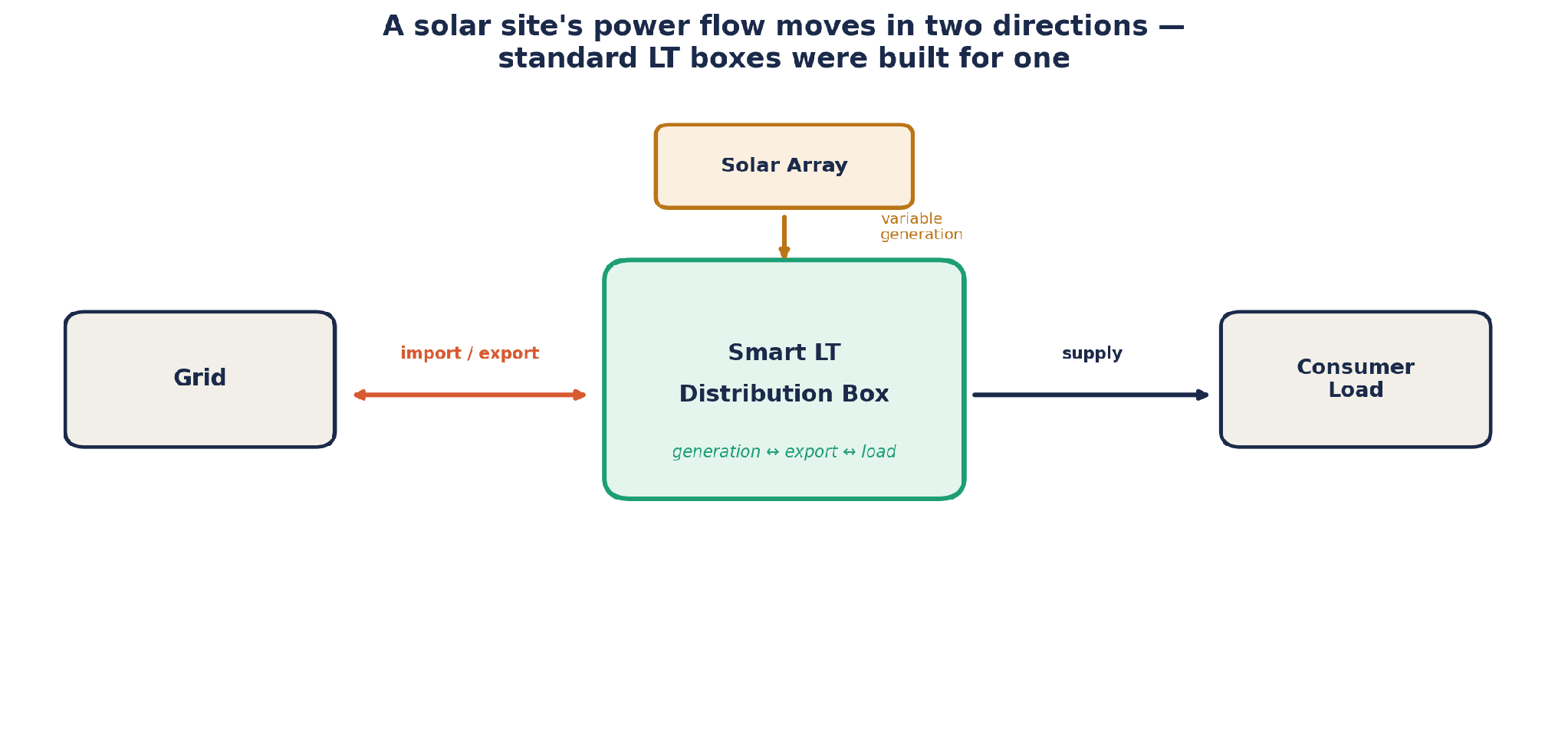
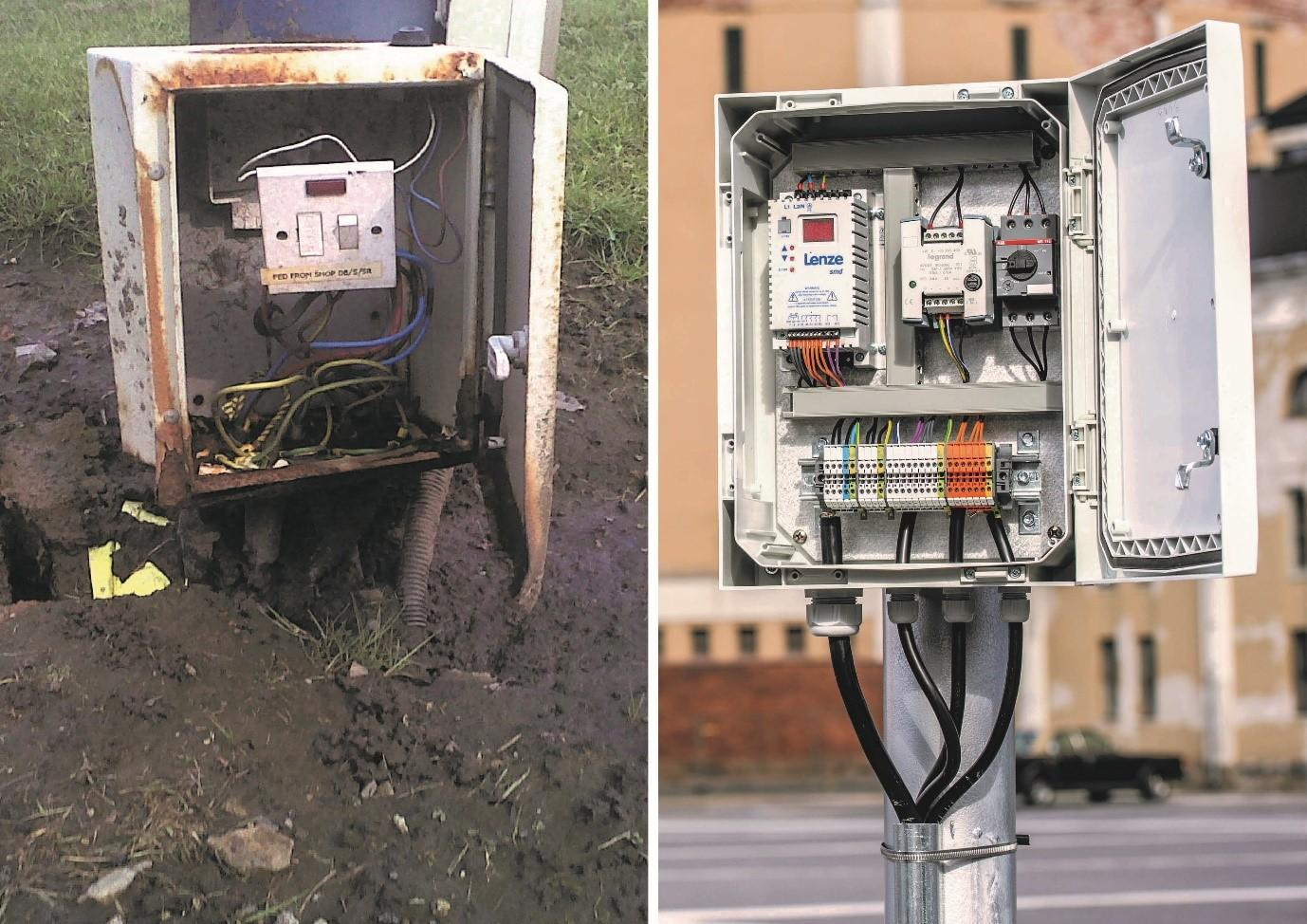
Standard LT boxes were built for one-way power flow — solar sites need two
Where Standard Distribution Boxes Fall Short on Solar Sites
Handling Bidirectional Power Flow
A smart LT distribution box can provide supplementary operational monitoring of electrical parameters. Import and export energy measurement for billing is performed by the approved bidirectional meter.
Monitoring Generation vs. Consumption Separately
Solar installations require appropriate metering and monitoring arrangements to track generation, consumption, and grid import or export. A smart LT distribution box can provide supplementary visibility into distribution-level electrical parameters, while approved metering equipment handles billing-related energy measurement.
Weatherproofing for Rooftop and Ground-Mount Exposure
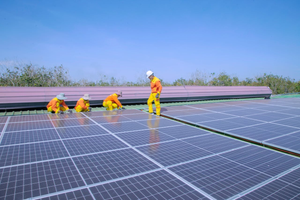
Rooftop installations sit in direct sun with limited shelter; ground-mount arrays sit exposed to dust, runoff, and — depending on the region — coastal salt or industrial pollution. These are frequently harsher conditions than a typical street-level LT distribution point, and the enclosure needs to be specified accordingly.
What “Smart” Actually Means in an LT Distribution Box
The word gets used loosely, so it’s worth being precise. In this context, “smart” means three specific capabilities working together, not a single feature:
- Real-time monitoring — continuous visibility into voltage, current, and power flow direction, not a monthly or quarterly reading
- Remote diagnostics — the ability to see a fault or an anomaly without a site visit
- Fault and tamper detection — flagging abnormal conditions (imbalance, unexpected reverse flow, unauthorized access) as they happen, not after a failure
These monitoring capabilities do not replace proper electrical design or approved metering arrangements. A smart LT distribution box can provide supplementary operational visibility at the LT distribution level, subject to the product’s verified specifications and installation requirements.
Why This Matters Specifically for EPC Contractors
Most of the case for smart distribution infrastructure gets made from the DISCOM’s point of view — grid stability, loss reduction, compliance. That’s real, but it’s not the EPC’s most immediate concern. The EPC’s stakes are commercial and specific.
Reducing Post-Commissioning Site Visits
Remote monitoring can help EPC contractors identify certain faults or abnormal conditions before arranging a site visit. Depending on the monitoring capabilities available, this visibility may help reduce diagnostic visits across multiple installations. Physical inspection and maintenance may still be necessary.
Simplifying Compliance and Net-Metering Documentation
Net-metering billing relies on approved metering arrangements for import and export energy measurement. Smart LT distribution boxes can provide supplementary operational visibility that may help EPC contractors monitor distribution-level conditions.
Protecting the EPC’s Warranty Exposure
When a fault occurs after handover, identifying its likely source can help EPC contractors investigate the issue and coordinate with the relevant equipment provider. Supplementary monitoring at the LT distribution level can help improve fault visibility and may help manage warranty-related issues. Actual warranty coverage depends on the applicable terms and conditions.
What to Look for When Specifying a Distribution Box for a Solar Project
| Requirement | Why It Matters for Solar Sites |
|---|---|
| Bidirectional monitoring capability | Supplementary monitoring capability; billing meter separately specified |
| Remote/real-time diagnostics | Can help identify potential issues remotely |
| IP rating matched to installation exposure | Rooftop and ground-mount sites often see harsher conditions than typical LT points |
| Non-conductive or hybrid enclosure body | Reduces touch-potential risk on publicly accessible or rooftop-adjacent installations |
| Certification and test documentation | Certification and test documentation | Verify applicable standards, product certifications, and DISCOM or project-specific approval requirements before specification and installation. |
| Design-stage material decision | Enclosure material and monitoring capability can’t be retrofitted cheaply after installation |
Hybrid enclosure construction — a non-conductive composite body with structural reinforcement — is one way this gets addressed at the design stage rather than after the fact, which is the same logic behind Pulse Box™‘s construction for LT distribution generally.
Frequently Asked Questions
Do solar EPC projects need a different distribution box than standard LT networks?
Not necessarily. The appropriate distribution box depends on the installation’s electrical design, power flow, environmental conditions, and monitoring requirements. Approved metering equipment handles import and export energy measurement for billing, while a smart LT distribution box may provide supplementary operational monitoring.
What is a smart LT distribution box?
A distribution box that combines real-time monitoring, remote diagnostics, and fault or tamper detection — giving continuous visibility into the network rather than periodic manual readings.
How does a smart distribution box help with net metering compliance?
Net-metering billing relies on approved metering arrangements for measuring imported and exported energy. A smart LT distribution box can provide supplementary monitoring and operational visibility at the LT distribution level, but it does not replace the approved bidirectional meter or establish billing compliance.
What IP rating is needed for a distribution box on a solar site?
It depends on the installation type and location — rooftop, ground-mount, coastal, or industrial sites all carry different exposure. As a general practice, treat solar-site enclosures as facing harsher conditions than typical street-level LT distribution points, and specify accordingly rather than defaulting to a standard rating.
Can smart distribution boxes reduce O&M costs for solar EPC contractors?
Remote monitoring can help identify certain faults or abnormal conditions before a site visit is arranged. Depending on the monitoring capabilities and site conditions, this may help reduce diagnostic visits and support maintenance planning. Physical inspection and maintenance may still be required.
Where to Start
Before specifying distribution infrastructure for a solar project, assess the approved metering requirements, the electrical design, the monitoring needs, and the environmental conditions at each installation site.
These factors should guide the selection of the distribution box and associated monitoring equipment for the specific project.
Read More:
- 7 Mistakes in Transformer Centre Safety—and How FRP Products Can Help
- Why FRP Fencing Is Changing Transformer-Centre Safety
RMC Switchgears has built enclosures and distribution equipment for Indian grid conditions since 1994, supplying DISCOMs, OEMs and EPC contractors nationwide from Jaipur.