Quick Answer
There is no universally better material for an outdoor electrical enclosure. For relatively dry, low-corrosion environments, properly designed and coated steel can offer excellent performance at a lower initial cost. As corrosion exposure increases — particularly in coastal, humid or aggressive industrial environments — SMC/FRP can become increasingly attractive because the enclosure body is not subject to electrochemical corrosion in the same way as steel.
The right comparison is therefore not simply price per enclosure. It is total cost of ownership over the expected life of the electrical asset.
Key Takeaways
- Material selection should be based on the actual installation environment, not on a blanket preference for steel or composite.
- Steel usually has an advantage in initial purchase cost and structural strength.
- SMC/FRP can offer significant advantages where corrosion, public safety and repeated maintenance are major concerns.
- Replacement, recoating, field labour and outages can materially change a 20-25 year lifecycle calculation.
- For public-facing electrical assets, the non-conductive nature of SMC/FRP can provide an additional layer of protection against enclosure-body touch potential.
- Hybrid construction can combine a composite external enclosure with internal metallic reinforcement where additional structural strength is required.
Declaring Our Interest Up Front
RMC Switchgears works with both metallic and composite enclosure technologies.
That matters because this comparison should not begin with the assumption that one material must win everywhere.
In many installations, steel may remain the most economical and technically appropriate solution.
In others — particularly locations exposed to severe corrosion, persistent moisture or public contact — the lifecycle economics can move strongly in favour of composite construction.
The question is not: “Which material is better?”
The better question is: “Which material is better for this particular site, duty and asset life?”
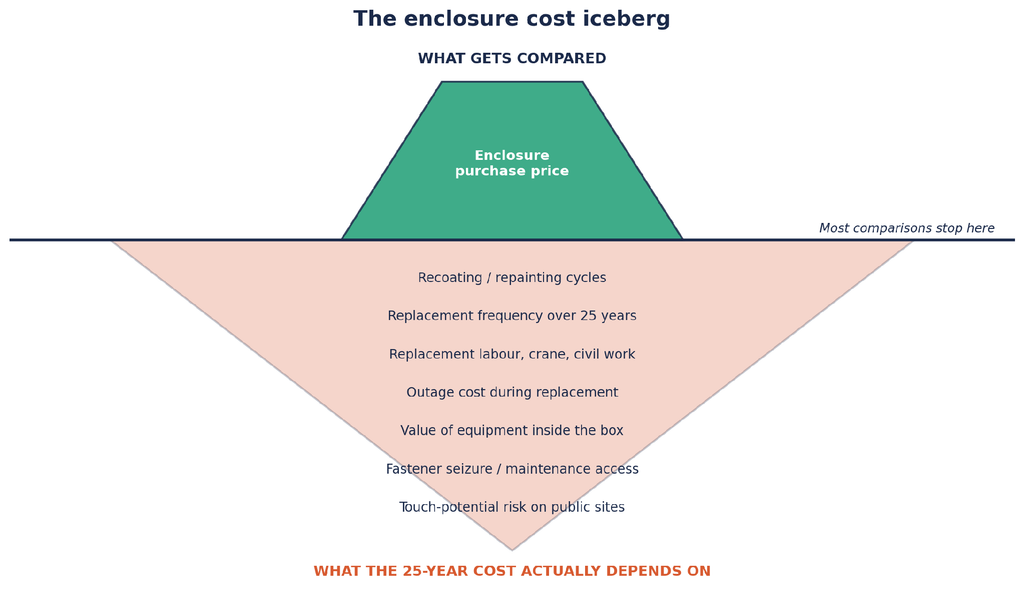
Why Purchase Price Alone Can Be Misleading
If an evaluation is based only on the purchase price of the enclosure, steel will often look more economical.
But an enclosure is not purchased simply to exist. It is purchased to protect electrical equipment, maintain safe operation and remain serviceable for many years.
A lifecycle comparison should therefore include more than the original invoice value.
Metal and composite materials also age differently.
Steel is vulnerable to electrochemical corrosion. Protective coating systems, galvanising and stainless-steel grades can substantially improve corrosion resistance, but the performance still depends on the environment, coating system, fabrication quality and maintenance.
SMC and FRP are not subject to electrochemical rusting like steel. Their long-term performance instead depends on factors such as resin system, UV resistance, mechanical loading, temperature, workmanship and environmental exposure.
So the useful comparison is: What does each solution cost per year of reliable service in the actual operating environment?
What a Proper 25-Year Cost Comparison Should Include
A meaningful lifecycle-cost calculation should consider at least the following.
| Cost Element | Often Included? | Why It Matters |
|---|---|---|
| Initial enclosure cost | Yes | Most visible cost at procurement stage |
| Installation labour | Sometimes | Can become significant at remote or difficult sites |
| Civil and mounting work | Sometimes | May need to be repeated if the enclosure is replaced |
| Coating maintenance | Often missed | Relevant for many metallic systems |
| Repair and repainting | Often missed | Adds recurring field cost |
| Replacement frequency | Often missed | Can dominate long-term economics |
| Replacement labour | Often missed | Includes dismantling and reinstallation |
| Crane / lifting / logistics | Often missed | Important for larger installations |
| Planned or unplanned outage | Rarely included | Can be more expensive than the enclosure itself |
| Internal equipment exposure | Rarely included | The enclosure protects assets worth many times its own cost |
| Fastener and access degradation | Rarely included | A cabinet that cannot be safely opened is an operational problem |
| Safety exposure | Difficult to quantify | Particularly important at public-facing installations |
This is why two enclosures with very different purchase prices can produce the opposite result when evaluated over 20 or 25 years.
Lifecycle Cost = Initial Cost + Maintenance + Repairs + Replacement + Labour + Civil Work + Logistics + Outage Impact
The values should ideally come from the utility’s own maintenance and replacement records rather than from assumptions supplied by a manufacturer.
Start With the Environment
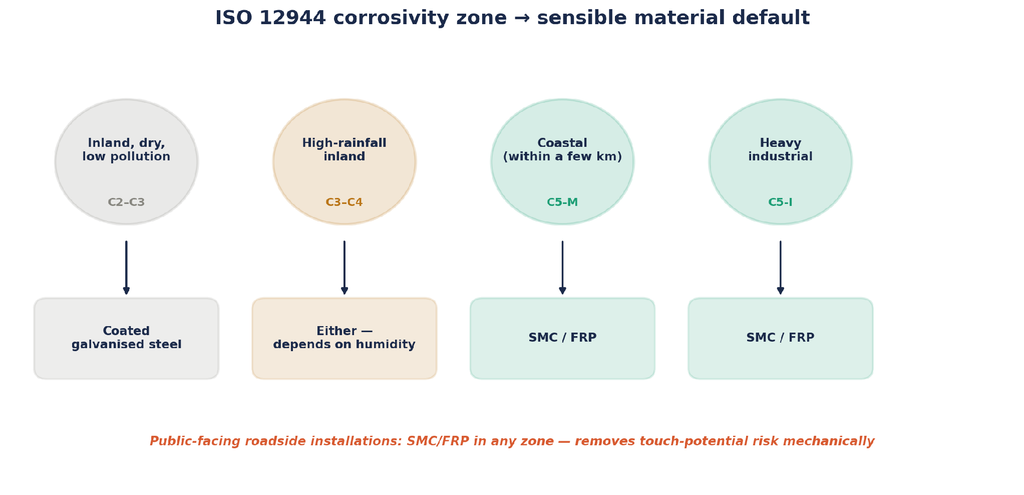
ISO 12944 provides a useful framework for classifying atmospheric corrosivity. The current approach includes categories ranging from relatively mild exposure through C5 and CX for very aggressive environments.
The material decision should follow the environment — not the other way around. A practical interpretation may look like this:
| Typical Environment | Indicative Corrosivity | Material Approach |
|---|---|---|
| Dry inland, low pollution | C2-C3 | Properly coated / galvanised steel can be highly suitable |
| Humid inland / moderate industrial | C3-C4 | Compare coating system, maintenance and composite options |
| Aggressive coastal / industrial | C5 | Composite becomes increasingly attractive |
| Extreme marine / offshore / highly aggressive exposure | CX | Requires specialised material and protection strategy |
| Public roadside electrical equipment | Varies | Electrical safety considerations become especially important |
These are not automatic material prescriptions. They are a starting point for engineering evaluation.
Actual performance depends on the complete design, including sealing, fasteners, coating thickness, ventilation, IP protection, resin formulation and installation quality.
Why Corrosion Changes the Economics
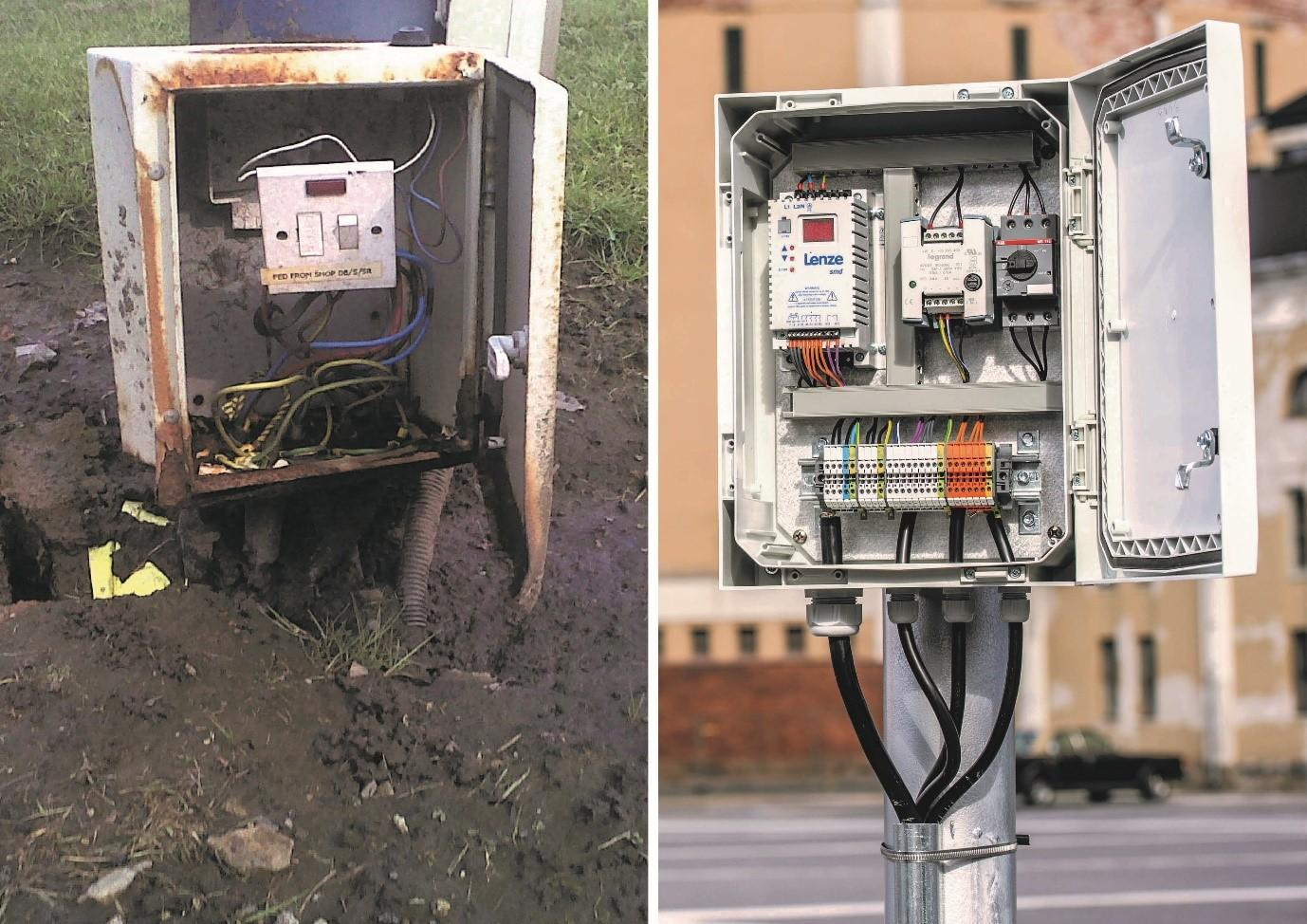
Corrosion does more than make an enclosure look old. It can affect:
- Door alignment
- Hinges
- Locking mechanisms
- Fasteners
- Sealing surfaces
- Earthing connections
- Mounting interfaces
- Ingress protection
- Maintenance access
An enclosure may therefore become operationally unacceptable well before the entire structure physically fails.
This is where composite materials can offer an advantage.
SMC/FRP does not rust like carbon steel, so chloride exposure and humidity do not create the same corrosion mechanism in the enclosure body.
That does not mean composite is maintenance-free or indestructible.
UV exposure, impact damage, poor formulation, improper moulding and mechanical overload can all affect long-term performance.
Good engineering means understanding the failure mode of each material — not pretending one of them has none.
What About Electrical Safety?
For public-facing distribution equipment, material selection is not only a corrosion question. It is also a safety question.
A metallic enclosure is conductive and therefore forms part of the electrical safety and earthing design. If insulation, earthing or bonding deteriorates, hazardous touch voltage can potentially appear on accessible conductive surfaces.
A properly designed SMC or FRP enclosure provides a non-conductive external body. This can significantly reduce the possibility of the enclosure surface itself becoming an exposed conductive path.
That does not eliminate the need for proper electrical protection. Internal metallic components, terminals, cables, reinforcement members and associated equipment still require correct insulation, protection and design.
So the advantage should be stated accurately: Composite construction can reduce enclosure-body touch-potential exposure; it does not replace proper electrical protection.
For installations near footpaths, housing colonies, markets, schools or other public areas, that additional layer of protection can be highly valuable.
Material Properties: A Practical Comparison
| Property | Painted Mild Steel | Galvanised Steel | Stainless Steel | SMC / FRP |
|---|---|---|---|---|
| Initial cost | Low | Low-Moderate | High | Moderate |
| Structural strength | High | High | High | Moderate-High depending on design |
| Electrochemical corrosion | Vulnerable | Better protected | Highly resistant depending on grade/environment | Not subject to rusting like steel |
| Electrical conductivity | Conductive | Conductive | Conductive | Non-conductive |
| Thermal conductivity | High | High | High | Lower |
| Weight | High | High | High | Lower |
| Coastal suitability | Depends heavily on protection system | Better, but environment dependent | Good with correct grade | Often attractive |
| Public-touch interface | Requires earthing/protection | Requires earthing/protection | Requires earthing/protection | Non-conductive body |
This table should be treated as an engineering overview — not as a substitute for a detailed specification.
Why Thermal Performance Matters More Than It Used To
Electrical enclosures increasingly contain electronics rather than only passive switching devices. That makes internal temperature more important.
Electronic components such as communication modules, power supplies, sensors, relays, communication gateways, and control electronics can experience reduced service life when exposed to sustained high temperatures.
For many aluminium electrolytic capacitors, manufacturers commonly use an Arrhenius-based approximation under defined operating conditions in which approximately every 10°C increase in operating temperature can significantly reduce expected life.
The exact temperature inside an enclosure, however, depends on much more than the enclosure material. It is influenced by solar radiation, enclosure colour, ventilation, internal losses, geometry, wall thickness, ambient temperature, and installation orientation.
Therefore, instead of assuming that one material will automatically run cooler, thermal performance should ideally be validated through calculation or testing for the specific design.
Where Steel Still Has a Clear Advantage
Structural strength remains one of steel’s major advantages.
Large equipment, high mechanical loads, heavy switchgear and locations subject to impact or vandalism may require substantial structural rigidity.
Composite construction can be engineered for strength, but the right solution does not always require choosing only one material. That leads to an increasingly useful approach.
The Hybrid Approach: Use Each Material Where It Performs Best
For LT distribution equipment, the better question may be: which material should be used where?
A hybrid design can place composite material at the weather and public interface, and metal reinforcement where structural loads have to be carried.
This approach can combine electrical insulation, corrosion resistance and reduced enclosure weight with structural rigidity, mounting strength and equipment support.
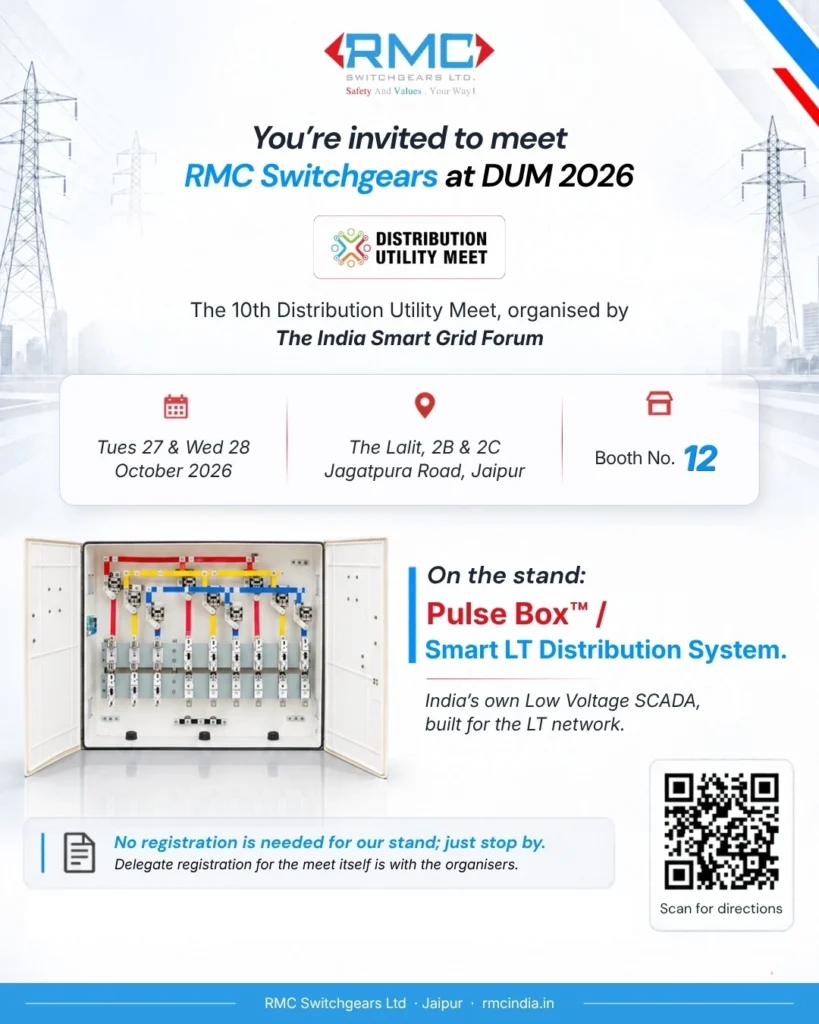
Pulse Box™ uses this design philosophy, combining an SMC external enclosure with structural reinforcement where required.
The important point is that material architecture is best decided during the design stage. It is much harder — and usually much more expensive — to correct an unsuitable enclosure-material decision after thousands of units have already been deployed.
A Better Way to Evaluate the Decision
Instead of comparing two quotations, utilities and EPC contractors can evaluate a representative site. Take Site A (inland installation) and Site B (coastal or aggressive installation). For each one, estimate:
- Initial enclosure cost
- Installation cost
- Likely maintenance interventions
- Coating or repair requirements
- Expected replacement interval
- Replacement labour
- Transport and civil work
- Expected outage impact
Then calculate: 25-year lifecycle cost ÷ expected service years. The same material may not win at both sites. And that is exactly the point.
Frequently Asked Questions
Is FRP better than metal for electrical enclosures?
Not universally. Steel can be an excellent choice in relatively mild environments where its strength and lower initial cost are attractive. SMC/FRP becomes increasingly valuable where corrosion, moisture, public-touch exposure and recurring maintenance materially affect lifecycle cost.
Does FRP corrode?
FRP and SMC do not undergo electrochemical rusting in the same way as steel. However, composite materials can still age through UV exposure, mechanical damage, environmental exposure and poor material formulation. Long service life therefore depends on correct material design and manufacturing quality.
How long does an FRP enclosure last compared with steel?
There is no credible universal number. Service life depends on environment, coating specification, resin system, UV stabilisation, mechanical load, maintenance and installation quality. A better comparison uses actual field-performance data from similar installations.
Is SMC electrically safer than metal?
SMC is non-conductive, so the external enclosure body does not act as a conductive metallic surface. This can reduce enclosure-body touch-potential risk. However, complete electrical safety still depends on insulation, protection, earthing of internal conductive components and correct installation.
Is FRP strong enough for outdoor electrical equipment?
For many electrical enclosure applications, yes — provided the enclosure is correctly engineered. Where higher mechanical loading is required, hybrid construction can combine a composite external shell with suitable structural reinforcement.
What should a lifecycle-cost calculation include?
At minimum: initial purchase cost, installation, maintenance, coating repairs, replacement frequency, replacement labour, logistics, civil work and outage impact. For important assets, the value and vulnerability of the equipment protected inside the enclosure should also be considered.
Where Should Utilities Start?
Before standardising an enclosure material across an entire network, classify the operating environments.
A utility may have dry inland circles, industrial clusters, high-rainfall districts, coastal regions, and dense public-facing urban installations. The same enclosure specification may not be economically optimal across all of them.
A better approach is: environment → risk → lifecycle requirement → material specification — rather than: one material → every location.
The Real Conclusion
The FRP-versus-metal discussion should not end with a universal winner.
Steel remains a highly capable and economical engineering material.
SMC and FRP solve a different set of problems — particularly corrosion exposure, electrical insulation and recurring maintenance.
In many installations, the most intelligent solution may even combine both.
The key is to stop comparing only the price of the enclosure and start comparing the cost of keeping the electrical asset safe and operational over its entire life. That is where the real 25-year comparison begins.
Read More
Mild Steel, Stainless or SMC: What Actually Survives an Indian Monsoon
7 Mistakes in Transformer Centre Safety—and How FRP Products Can Help
Do Anti-Theft Meter Boxes Really Help Reduce AT&C Losses?
Electrical Safety in LT Distribution Networks
About RMC Switchgears
RMC Switchgears develops electrical distribution, enclosure and safety solutions for utilities, EPC contractors and infrastructure customers across India.
Its portfolio spans metallic and composite enclosures, FRP safety solutions, electrical distribution equipment and intelligent LT-network solutions including Pulse Box™.