The Indian power sector is currently undergoing its most significant transformation in decades. Under the Revamped Distribution Sector Scheme (RDSS), the traditional model of utility-managed metering is being replaced by the Advanced Metering Infrastructure Service Provider (AMISP) model.
For the uninitiated, this shift isn't just a technical upgrade; it is a fundamental change in how the grid operates. AMISPs are now tasked with the "Build-Own-Operate-Transfer" (BOOT) responsibility. This means the service provider is responsible for everything from the meter installation to data communication and maintenance for a decade or more.
But here is the catch: The entire financial viability of an AMISP depends on reliability. If the data doesn't flow, the revenue doesn't grow. At RMC Switchgears Ltd., we have spent over 30 years perfecting the infrastructure that protects these investments. In this blog, I want to dive deep into why reliability is the only metric that matters for AMISPs today and why the "LT interface" is the real battleground for AT&C loss reduction.
The Ground Reality: The High Stakes of the BOOT Model
In the old days, if a meter failed, it was a headache for the DISCOM. In the RDSS era, if a smart meter goes offline or is tampered with, it is a direct financial penalty for the AMISP. Most contracts today come with strict service level agreements (SLAs).
As per industry standards, AMISPs often have a very narrow window: sometimes as little as 14 working days: to rectify hardware or communication failures before facing liquidated damages or even contract termination. When you are managing millions of nodes, a failure rate of even 1% can be catastrophic for your bottom line.

Why the "Smart" Meter is Only Half the Story
There is a common misconception that "Smart Metering" is all about the meter itself: the silicon, the communication module, and the software. While those are vital, they are also incredibly vulnerable. A $50 smart meter is only as good as the $10 enclosure protecting it.
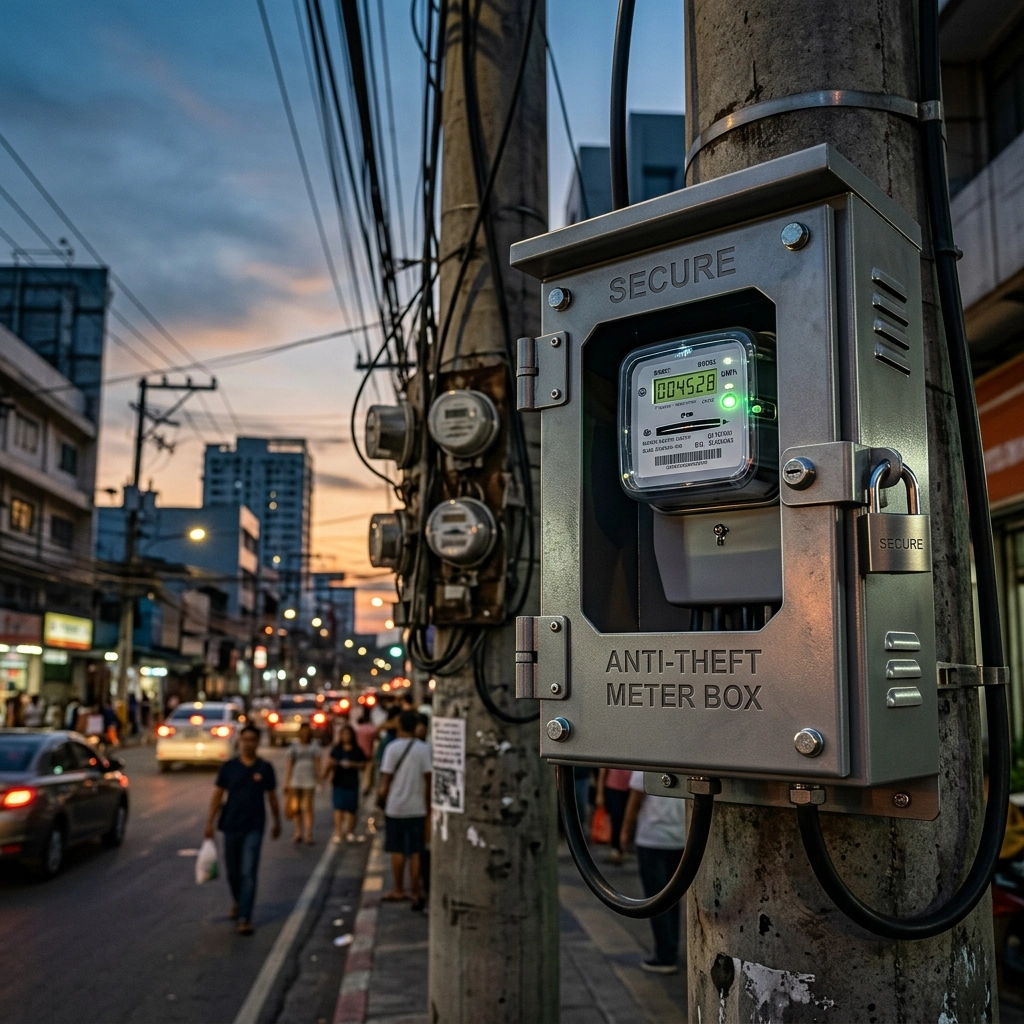
If a bad actor can bypass the meter, bridge the terminals, or physically damage the unit because the enclosure was flimsy, the "smart" features become irrelevant. Reliability in the AMISP world isn't just about electronic uptime; it’s about physical integrity.
01. The ROI Trap: Why Hardware Failures Kill Profits
For an AMISP, the Return on Investment (ROI) is calculated over 7 to 10 years. This requires the hardware to survive harsh Indian summers, torrential monsoons, and high-salinity coastal environments without degrading.
The Consequence Chain of Poor Reliability:
- Component Failure: A low-quality plastic meter box cracks under UV exposure.
- Environmental Ingress: Dust and moisture enter the smart meter, causing a short circuit.
- Data Gap: The meter stops transmitting consumption data to the Head-End System (HES).
- Penalty: The DISCOM penalizes the AMISP for "Zero Data" nodes.
- Operational Expense (OPEX): The AMISP must send a technician to a remote location for replacement, eating up the year's profit from that single node.
By choosing high-quality metering enclosures, AMISPs can effectively "set it and forget it," ensuring the LT interface remains secure for the entire contract duration.
02. Tamper-Proofing the LT Interface
The primary goal of RDSS is to bring down AT&C (Aggregate Technical & Commercial) losses. Commercial losses are largely driven by theft and tampering. AMISPs are essentially being paid to "recover" this lost electricity.
Traditional metal boxes are prone to corrosion and are easily manipulated. At RMC Switchgears, we pioneered the use of SMC (Sheet Moulding Compound) and FRP (Fibre Reinforced Plastic) for electrical enclosures.
Why SMC/FRP is the Gold Standard for AMISPs:
- Non-Conductive: Eliminates the risk of electric shock and prevents "neutral tampering" via the box body.
- Corrosion Proof: Unlike metal, SMC does not rust, ensuring a 20+ year lifespan even in humid climates.
- Anti-Tamper Design: Our enclosures are designed with hidden hinges and high-security locking mechanisms that make unauthorized access nearly impossible without leaving visible evidence.

Caption: A high-durability SMC Smart Metering Enclosure designed for RDSS deployments, ensuring 360-degree protection.
03. 30 Years of Expertise: The RMC Advantage
Reliability cannot be engineered overnight. It comes from decades of observing how infrastructure fails in the field. Having served major DISCOMs across India for over three decades, we understand the local challenges that global providers often overlook.
We don't just provide a box; we provide a secure LT interface. This includes everything from the incoming cable to the meter housing and the outgoing connections. By securing this entire chain, we help AMISPs maintain high uptime and ensure that every unit of energy delivered is accurately recorded and billed.
Our commitment to quality was recently recognized on a global stage when RMC Switchgears Ltd. received the Forbes Asia 'Best Under A Billion' award. This recognition underscores our role as a trusted partner in India's energy transition.

04. Shifting from "Product" to "Digital Asset"
In the current landscape, we are seeing a shift in how infrastructure is perceived. An enclosure is no longer just a piece of hardware; it is a protector of a digital asset.
AMISPs are increasingly looking for "Smart Enclosures." While the meter handles the billing data, the enclosure must handle the environmental and security data. This is why we focus on:
- UV Stabilization: Ensuring the box doesn't become brittle and breakable over time.
- Heat Dissipation: Smart meters generate heat; our enclosures are engineered to maintain optimal internal temperatures to prevent electronic aging.
- Standardization: Ensuring that our products meet and exceed the latest RDSS technical specifications.
| Feature | Traditional Metal Box | RMC SMC/FRP Enclosure |
|---|---|---|
| Lifespan | 5-7 Years (with maintenance) | 20+ Years (Zero maintenance) |
| Safety | High risk of leakage current | 100% Insulated / Shock-proof |
| Tamper Resistance | Low (Easy to bend/drill) | High (Impact resistant/Rigid) |
| Weight | Heavy / Hard to install | Lightweight / Easy deployment |
| Total Cost of Ownership | High (Due to replacements) | Low (Long-term reliability) |
05. The Strategic Choice: Partner, Not Just a Vendor
For an AMISP, the choice of an infrastructure partner is a strategic decision that affects the project's Internal Rate of Return (IRR). Selecting a vendor based solely on the lowest bid often leads to high OPEX costs later in the project lifecycle.
When you partner with a legacy player like RMC, you aren't just buying a product. You are buying the peace of mind that comes from:
- Proven Track Record: Millions of our enclosures are already operational in the field.
- Compliance: Our products are tested at NABL-accredited labs to ensure they meet the highest safety standards.
- Scalability: Our manufacturing capacity allows us to support large-scale RDSS rollouts without compromising on delivery timelines.

Conclusion: Reliability is the Only Way Forward
As the RDSS rollout accelerates, the conversation around AMISP reliability will only get louder. The companies that succeed will be those that realize the "smart" grid is built on a foundation of "rugged" hardware.
At RMC Switchgears, we are proud to be the silent guardians of this digital revolution. We ensure that while the meters do the talking, our enclosures do the protecting.
If you are an AMISP or a utility professional looking to fortify your LT infrastructure and secure your long-term ROI, let’s talk. Our team is ready to help you navigate the complexities of RDSS compliance and hardware reliability.
Explore our range of solutions:
Reliability isn't just a feature: it's your bottom line. Let's build a more secure grid, together.