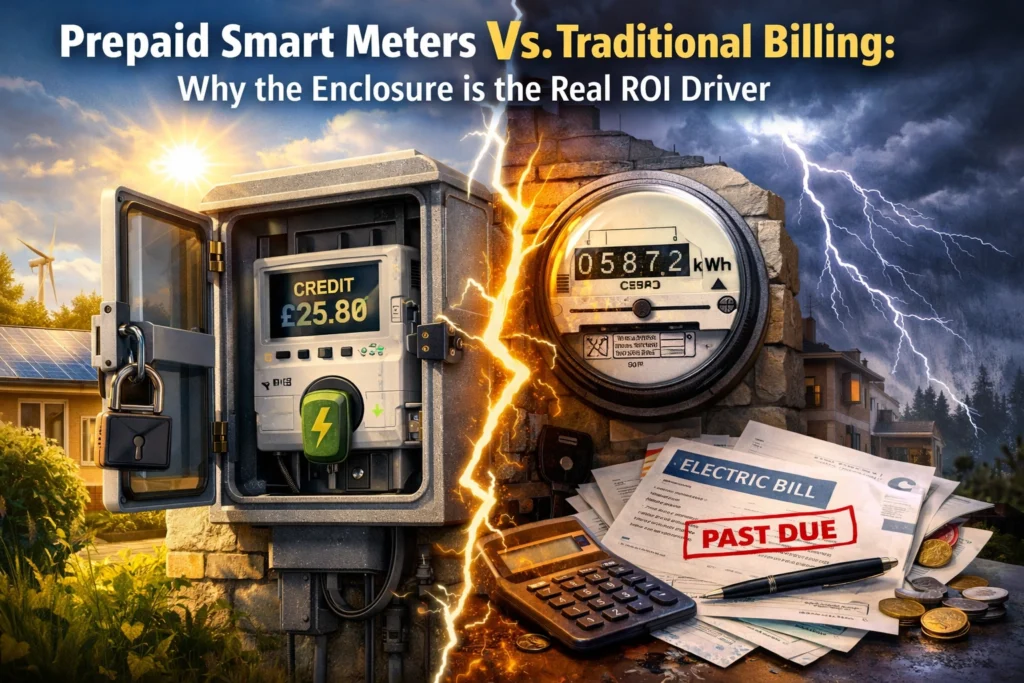
The Indian power sector is currently undergoing its most significant transformation since independence. Under the Revamped Distribution Sector Scheme (RDSS), the government has set an ambitious target to replace 250 million conventional meters with prepaid smart meters. The logic is sound: eliminate manual reading errors, ensure upfront payment for energy consumed, and drastically reduce Aggregate Technical and Commercial (AT&C) losses that have plagued DISCOMs for decades.
However, there is a multi-billion-rupee flaw in the current strategy of many utilities and Advanced Metering Infrastructure Service Providers (AMISPs). While millions are spent on the "intelligence" of the meter: the communication modules, the software, and the silicon: the physical security of that asset is often treated as an afterthought.
At RMC Switchgears Ltd., we view this as a critical failure in ROI calculation. If a smart meter is housed in a substandard enclosure, the "smart" technology becomes irrelevant the moment it is bypassed or damaged. The enclosure is not just a box; it is the bodyguard of your investment.
The Ground Reality: The High Cost of Traditional Billing
For decades, the traditional postpaid billing system has been the primary source of financial leakage for Indian DISCOMs. The "Consequence Chain" of traditional billing is clear:
- Manual Intervention: Relying on human meter readers leads to data entry errors or, worse, collusion for under-reporting.
- Delayed Revenue Cycles: Energy is consumed today, billed 30 days later, and paid (potentially) 15 days after that. This 45-day gap creates massive working capital pressure.
- The Collection Gap: Recovering dues from defaulting consumers is a legal and administrative nightmare.
- Physical Vulnerability: Old-school metal meter boxes are prone to rusting, making them easy to pry open for "jugaad" (illegal bypassing).
Traditional billing isn't just slow; it is fundamentally incapable of providing the granular data needed to manage a modern, high-load grid.
01. The Smart Meter Promise: Why the Shift Matters
The transition to prepaid smart meters changes the game by introducing real-time visibility and control. For the first time, DISCOMs can see exactly where power is flowing and, more importantly, where it is disappearing.
- Upfront Liquidity: Consumers pay before they consume, immediately improving the DISCOM’s cash flow.
- Remote Management: No more manual disconnections. The system can remotely cut off supply for non-payment or load violations.
- Accurate Data: Smart meters provide high-frequency data that allows for better load forecasting and peak-shaving strategies.
But here is the catch: A smart meter can only report what it measures. If a consumer manages to bypass the meter entirely because the enclosure was easily compromised, the digital "intelligence" of the system will report that everything is fine while the DISCOM continues to bleed revenue.
02. The Agitation: Why "Cheap" Enclosures Kill Smart Meter ROI
The ROI of an RDSS rollout is calculated over a 7-to-10-year horizon. However, many AMISPs are opting for low-quality metal enclosures or subpar plastic boxes to save on initial CAPEX. This is a classic "penny wise, pound foolish" scenario.
The Failure of Metal Enclosures
In the harsh Indian climate: ranging from the coastal humidity of Gujarat to the extreme heat of Rajasthan: traditional metal boxes fail rapidly.
- Corrosion: Rust sets in within 12–24 months, compromising the structural integrity of the box.
- Safety Hazards: A rusted metal box becomes a conductor. In many rural areas, "leakage" from faulty wiring into a metal enclosure has led to fatal electrocutions.
- Easy Tampering: Once a metal box is weakened by rust, it can be easily bent or pried open with simple tools, allowing for undetected meter bypassing.

Suggested Visual: Side-by-side comparison of a corroded metal box and a pristine RMC SMC box after 5 years of field exposure.
03. The RMC Solution: Engineering the Ultimate Bodyguard
To secure the ROI of smart metering, the industry must shift its focus toward SMC (Sheet Moulding Compound) Enclosures. As a leader in electrical infrastructure solutions, RMC Switchgears has pioneered the use of high-grade SMC to create tamper-proof meter boxes that act as a fortress for the meter.
Why SMC is the Gold Standard for RDSS
Our SMC enclosures are engineered to solve the specific physical challenges of the Indian grid:
| Feature | RMC SMC Enclosures | Traditional Metal Boxes |
|---|---|---|
| Material Life | 20+ Years | 3–5 Years (average) |
| Corrosion Resistance | 100% Rust-proof | High vulnerability |
| Electrical Safety | Non-conductive (Electrocution-proof) | Conductive (High risk) |
| Tamper Resistance | High Impact Strength, specialized seals | Easily bent or pried |
| Maintenance | Zero maintenance required | Periodic painting and repair |
| Thermal Stability | Fire retardant (V0 grade) | Can deform or conduct heat |
Preventing the "Bypass"
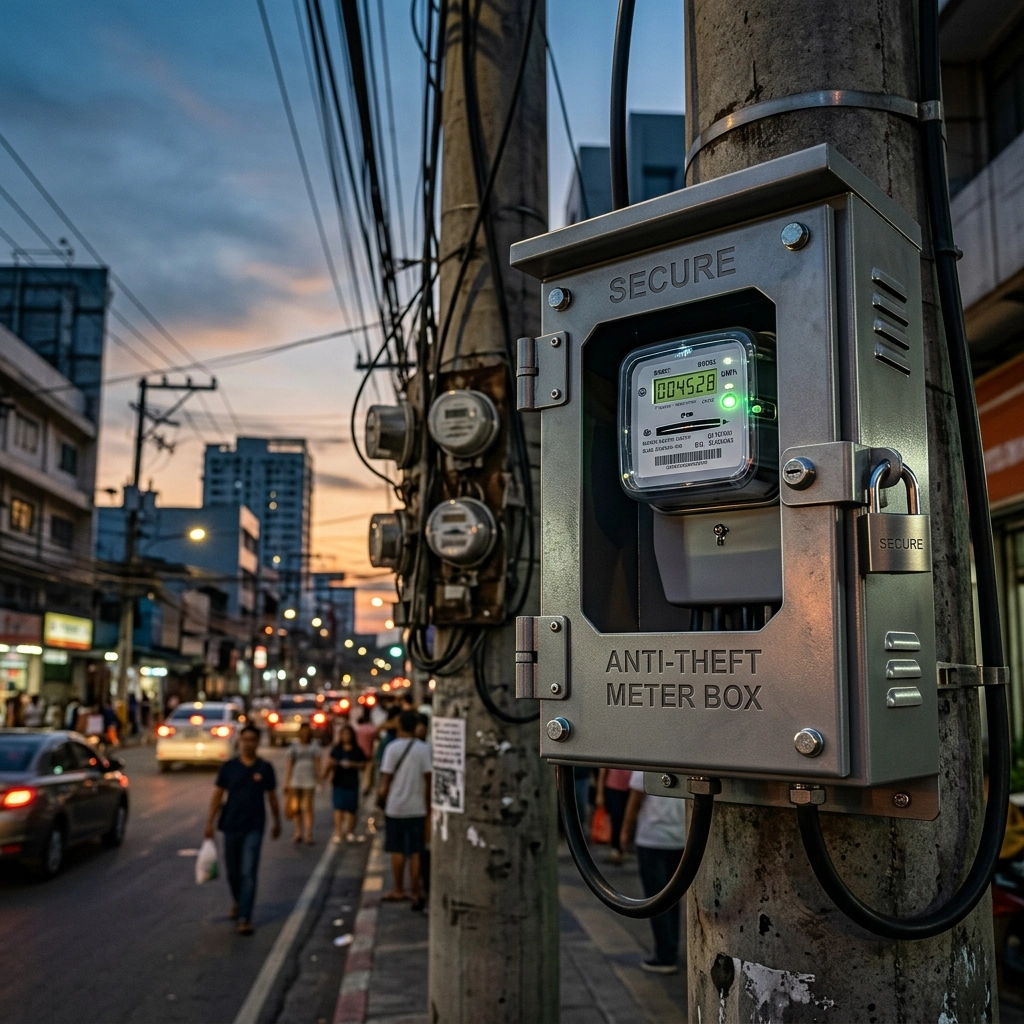
The primary goal of a smart meter enclosure is physical security. RMC’s meter boxes feature specialized locking mechanisms and tamper-evident designs. Because SMC is a high-strength composite, it does not "give" like thin-gauge metal. If someone attempts to break into an RMC box, the effort required is significant and leaves obvious physical evidence, acting as a massive deterrent to electricity theft.

04. Data-Driven Evidence: The Financial Impact of Enclosure Quality
Let’s look at the numbers. Consider a DISCOM deploying 100,000 smart meters.
- Scenario A: Cheap metal enclosures (Initial savings of ₹200 per unit). Total initial savings: ₹2 Crores.
- Scenario B: RMC SMC Enclosures. Higher initial CAPEX, but 100% rust-proof and tamper-resistant.
Within 3 years, Scenario A will face a 15-20% failure rate due to corrosion and a 10% increase in "undetected" tampering losses. The cost of replacing those 20,000 boxes, plus the lost revenue from theft, far exceeds the initial ₹2 Crore savings.
By contrast, Scenario B maintains the integrity of the billing cycle. By preventing just 2% of potential theft across the 10-year lifespan of the meter, the RMC enclosure pays for itself five times over. This is why we say the enclosure is the real driver of ROI.
05. A Legacy of Trust and Recognition
Securing India's power grid is a task that requires institutional reliability. RMC Switchgears Ltd. has been at the forefront of this mission for years. Our commitment to quality and innovation has not gone unnoticed. In 2025, RMC Switchgears was recognized by Forbes Asia as one of the 'Best Under A Billion' companies, a testament to our growth and the trust utilities place in our solutions.

This recognition is more than just a trophy; it reflects our success in strengthening the LT interface, which is the most critical and vulnerable part of the power distribution chain.
06. Strategic Implementation: How to Deploy for Long-Term Success
For DISCOMs and AMISPs, the path forward involves three strategic steps:
- Specify Material Excellence: Move away from generic "plastic" or "metal" specs. Demand high-grade SMC with UV stabilization and V0 fire-retardant properties.
- Focus on the Seal: Ensure the enclosure design supports modern sealing technologies that are impossible to replicate by unauthorized personnel.
- Evaluate Total Cost of Ownership (TCO): Stop looking at the cost of the box in isolation. Look at the cost of the box plus the cost of a replaced meter plus the cost of 10 years of potential energy theft.
Conclusion: Don't Let Your Smart Grid Have a Weak Link
The RDSS rollout is a once-in-a-generation opportunity to fix the financial health of the Indian power sector. Smart meters are the "brain" of this new grid, but that brain needs a skull to protect it.
Choosing a substandard enclosure is like buying a high-end security system and leaving the front door made of cardboard. It simply doesn't make sense. By investing in RMC Switchgears’ SMC solutions, you aren't just buying a box; you are buying an insurance policy for your revenue, your infrastructure, and the safety of the public.
Are you ready to secure your smart metering ROI?
Explore our range of smart meter enclosures or connect with our technical team to discuss how we can support your RDSS implementation with tamper-proof, high-durability solutions.