Let’s be honest: in the world of power distribution, we talk a lot about "smart grids" and "digital transformation." But while we’re busy looking at the high-tech horizon, there is a massive leak in the basement. That leak is AT&C (Aggregate Technical and Commercial) losses, and for many DISCOMs, it’s the difference between a thriving utility and a struggling one.
If you’re managing a distribution network, you already know the numbers. India's average AT&C losses have hovered around 15-20% for years, though some regions see much higher figures. A huge chunk of that isn't technical, it’s commercial. We’re talking about energy theft, meter tampering, and unauthorized access.
So, do you really need anti-theft meter boxes? If you care about revenue recovery, grid safety, and long-term ROI, the answer isn’t just "yes", it’s "how fast can we install them?"

The Ground Reality: The High Cost of "Good Enough"
The traditional approach to metering has often been "just put it in a box." Usually, that meant a basic metal enclosure. The problem is that these traditional setups are essentially an open invitation for tampering.
When we talk about the consequence chain of poor meter protection, it looks like this:
- Unauthorized Access: Weak hinges or flimsy locks are easily bypassed.
- Revenue Leakage: Once inside, bypassing the meter or using magnets to slow it down is trivial.
- Technical Failure: Exposure to weather leads to corrosion, causing short circuits.
- Safety Hazards: Tampered meters are fire risks, endangering both the public and your field staff.
At RMC Switchgears Ltd., we see these failures every day. We’ve realized that a meter box shouldn't just be an enclosure; it should be a security asset.
01. The "Commercial" in AT&C: Stopping Theft at the Source
Commercial losses are largely driven by human ingenuity, the wrong kind. From "hooking" to sophisticated magnetic interference, thieves are always finding ways to get power for free.
Why Traditional Boxes Fail:
- Magnetic Interference: Thin metal or plastic boxes provide zero shielding.
- Mechanical Vulnerability: External hinges are easily cut.
- Seal Manipulation: Traditional lead seals are easily faked or bypassed.
How Anti-Theft Enclosures Fix It:
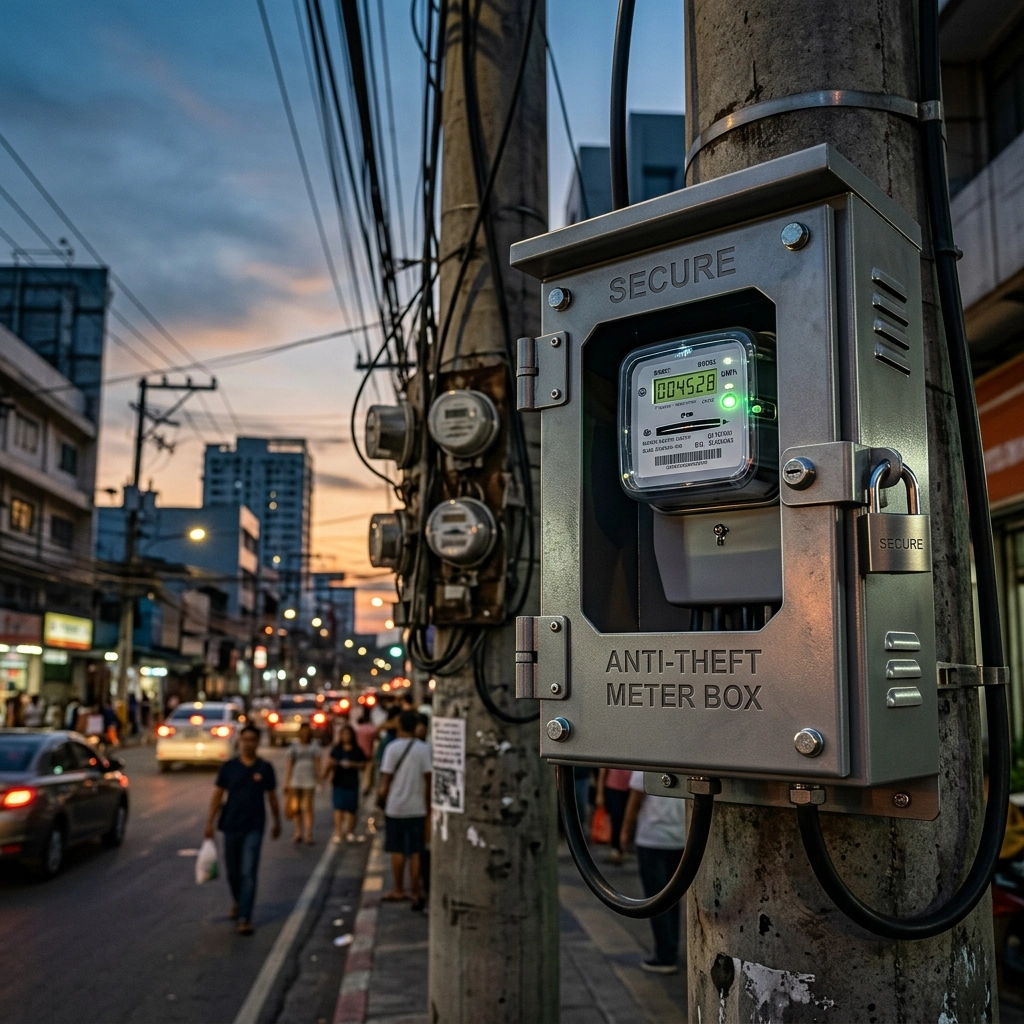
Our meter box for energy meters is designed with a "fortress mentality." We use high-grade SMC (Sheet Moulding Compound) and FRP (Fibre Reinforced Polymer). These materials are non-conductive and incredibly tough.
But the real magic is in the design. We’re talking about hidden hinges, multi-point locking systems, and tamper-evident seals that make it virtually impossible to gain entry without leaving a very obvious trail. When the barrier to entry is high, the "casual" thief moves on, and your revenue stays where it belongs.
02. The "Technical" in AT&C: Material Science Matters
It’s easy to forget that technical losses aren't just about long transmission lines. They happen right at the connection point.
Traditional metal boxes have a shelf life. They rust, they dent, and they conduct heat. In a country with extreme summers and heavy monsoons, a metal box can become a literal oven for the electronics inside. High heat increases resistance, which increases technical loss.
The SMC/FRP Advantage:
- Corrosion Resistance: Unlike metal, FRP doesn't care about rain or humidity. It doesn't rust. Period.
- Thermal Insulation: SMC has excellent thermal properties, keeping the internal environment stable and extending the life of the meter.
- Safety (Non-Conductivity): If a wire comes loose inside a metal box, the entire enclosure becomes live. With our FRP solutions, that risk is eliminated.

Caption: A side-by-side comparison showing the durability of SMC/FRP enclosures vs. corroded traditional metal boxes after 5 years of field exposure.
03. Smart Metering: From Hardware to "Digital Assets"
We are moving into the era of the Smart Grid. But a smart meter inside a "dumb" box is a wasted investment. If someone can simply smash the box and cut the communication module, your "smart" data goes dark.
This is why we developed the Pulsebox. It’s not just a box; it’s an IoT-enabled smart distribution enclosure.

By integrating smart enclosures into your projects and innovations strategy, you gain:
- Real-time Tamper Alerts: The moment a box is opened or tilted, your central station knows.
- Remote Monitoring: Track load and health at the edge of the grid.
- Data-Driven Maintenance: Stop sending crews out for "routine checks" and start sending them where the data says there’s a problem.
The ROI Calculation: Why DISCOMs Can’t Afford to Wait
I often get asked by executives about the "upfront cost" of high-end anti-theft enclosures. My response is always the same: Look at the lifecycle cost, not the purchase price.
Metal Enclosure vs. RMC SMC/FRP Enclosure
| Feature | Traditional Metal Box | RMC SMC/FRP Enclosure |
|---|---|---|
| Lifespan | 3–5 Years (due to rust) | 20+ Years |
| Tamper Resistance | Low (easy to bend/cut) | High (impact resistant, hidden hinges) |
| Maintenance | High (painting, rust removal) | Zero |
| Safety | Conductive (Risk of shock) | Non-conductive (Maximum safety) |
| Smart Compatibility | None | IoT/Pulsebox Ready |
When you factor in the reduction in energy theft (commercial loss) and the drastically lower replacement rate, the ROI usually hits 100% within the first 12–18 months. After that, it’s pure savings for the DISCOM.
04. Compliance and Validation: Engineering Trust
In the utility sector, "trust" is built on certifications and results. At RMC, we don't just claim our boxes are tough; we prove it. Our manufacturing facility, the heart of our company, is geared towards meeting and exceeding international standards.

We’ve been recognized on the global stage, including being named one of the Forbes Asia 'Best Under A Billion' companies. This isn't just a trophy for the shelf; it's a validation of our commitment to building infrastructure that actually works for the long haul.
05. The Deployment Flow: How to Start Slashing Losses
If you're looking to upgrade your network, you don't have to boil the ocean. A strategic rollout often looks like this:
- Identify High-Loss Feeders: Use your existing data to find the areas where the gap between power sent and power billed is the widest.
- Pilot Anti-Theft Enclosures: Deploy RMC anti-theft boxes in these "hot zones."
- Measure and Validate: Compare the billing cycles before and after installation.
- Scale: Use the recovered revenue from the pilot to fund the wider rollout.
This self-funding model is how the most innovative DISCOMs are modernizing their grids today.
The Verdict: Necessity, Not Luxury
So, do you really need anti-theft meter boxes?
If you are okay with losing 20% of your revenue to theft and technical inefficiency, then no. But if you want a grid that is safe, sustainable, and profitable, then anti-theft enclosures are the single most effective "low-hanging fruit" available to you.
At RMC Switchgears, we’re proud to be at the forefront of sustainability and grid efficiency. We don't just sell boxes; we sell peace of mind for utility managers and safety for the public.
Ready to see the data for yourself?
Whether you're looking for technical specifications or want to discuss a pilot opportunity for your region, our team is ready to help.
- Explore our full range: Products & Solutions
- Get in touch: Contact Our Engineering Team
- Stay Updated: Latest News and Innovations
Let’s stop the leakage and start building a smarter, safer grid together.