Quick Answer
FRP and metal enclosures don’t have a universal winner. The deciding variable is site corrosivity under ISO 12944. Inland, dry, low-pollution sites are well served by coated galvanised steel at lower capital cost. Coastal and heavy-industrial sites see composite (FRP/SMC) pull ahead decisively on 25-year cost, because it removes the corrosion mechanism rather than slowing it down.
Comparing purchase price alone will always favour steel. That comparison is also incomplete — see why below.
Key Takeaways
- There is no universally “better” material — the correct choice depends on ISO 12944 site corrosivity classification (C1 through C5-M/C5-I), not on marketing claims.
- Capital cost always favours steel. Lifetime cost inverts in coastal (C5-M) and heavy-industrial (C5-I) zones.
- The single most-omitted cost line in most comparisons is replacement frequency over a 25-year asset life — often the largest cost term of all.
- On public-facing roadside installations, FRP/SMC removes touch-potential risk mechanically — a safety consideration that can override the cost math entirely.
- Hybrid construction (composite envelope + steel reinforcement) is a design-stage decision, not something you retrofit later.
Declaring the Interest Up Front
RMC manufactures enclosures in mild steel, stainless steel, SMC and BMC. We sell both sides of this comparison.
That’s worth stating because most material comparisons are written by someone who makes one of the materials. We have no commercial reason to reach a universal verdict, and we’re not going to.
For a large share of Indian sites, the correct answer is steel.
Why Capital Cost Comparison Misleads
Compare purchase prices and steel wins nearly everywhere. Compare cost over a 25-year asset life and the answer inverts in specific, predictable conditions.
The reason: the two materials fail differently. Steel corrodes — a progressive electrochemical process that a coating slows but never stops. Composite doesn’t corrode electrochemically at all; it degrades through UV exposure and mechanical damage instead, on a different and generally slower curve.
The honest comparison isn’t price per box. It’s cost per year of service in your actual environment.
The Cost Lines a Proper Comparison Includes
A rupee total isn’t given here deliberately — it would be a fabricated number, since the real answer depends on your corrosivity category, labour rates, terrain, and outage costs. What follows instead is the framework: the cost lines that belong in the calculation, several of which are routinely left out.
| Cost Line | Usually Included? | Why It Matters |
|---|---|---|
| Enclosure purchase price | Always | The only line most comparisons contain |
| Installation labour and civil work | Sometimes | Broadly similar for both materials |
| Recoating / repainting cycles | Rarely | Steel in C4-C5 needs periodic recoating; composite does not |
| Replacement frequency over 25 years | Rarely | Usually the largest single cost term |
| Replacement labour, crane, civil work | Rarely | Often several times the material cost |
| Outage cost during replacement | Almost never | Regulator-visible for a DISCOM |
| Value of equipment inside | Almost never | The box protects assets worth many times itself |
| Fastener seizure / maintenance access | Rarely | A box that can’t be opened has failed |
| Touch-potential risk on public sites | Almost never | Hard to price, real nonetheless |
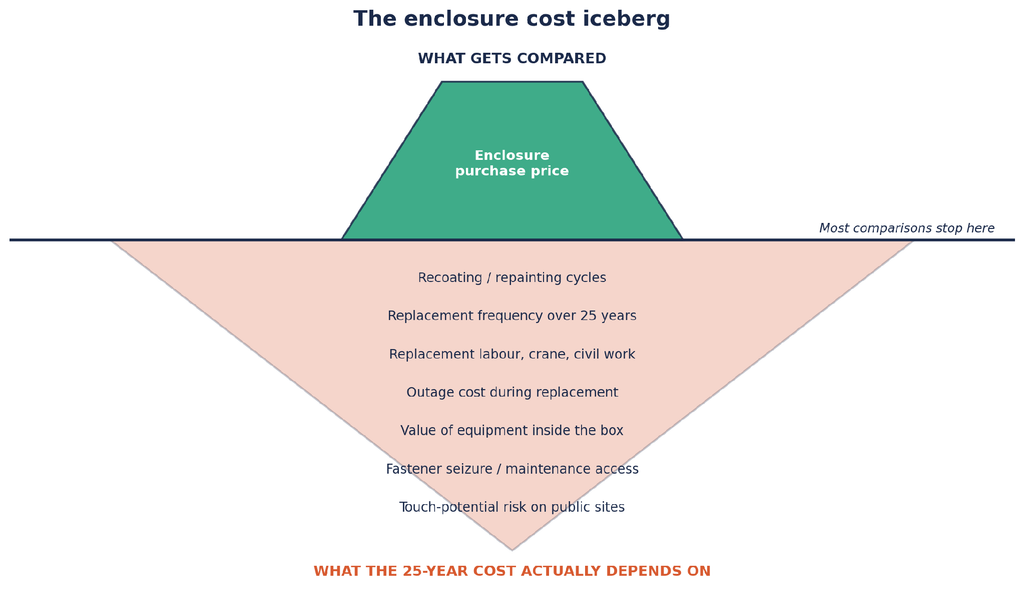
What most comparisons measure sits above the waterline. What decides the real 25-year outcome sits below it.
The replacement-frequency line is where the comparison is usually decided. An enclosure replaced at year eight instead of year twenty-two hasn’t cost one replacement — it has committed you to two extra replacement cycles, each carrying full labour, civil work and an outage.
Where the Crossover Sits: Matching Material to Site Corrosivity
ISO 12944-2 grades atmospheric corrosivity from C1 through C5-M (marine) and C5-I (industrial). That classification is the single best predictor of which material wins on lifetime cost.
| Environment | ISO 12944 | Sensible Default | Reasoning |
|---|---|---|---|
| Inland, dry, low pollution | C2-C3 | Coated galvanised steel | Corrosion rate low enough that coating life approaches asset life. Steel is cheaper and stronger. |
| High-rainfall inland | C3-C4 | Either — depends on humidity persistence | Recoating cycles start to matter |
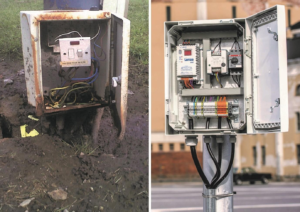
| Coastal, within a few km | C5-M | SMC / FRP | Chloride-driven pitting and crevice corrosion attack sealing surfaces; coating life falls sharply |
| Heavy industrial | C5-I | SMC / FRP | Acidic and alkaline condensate attack coatings continuously |
| Public roadside, any zone | C3-C5 | SMC / FRP | Non-conductive body removes the touch-potential failure mode |
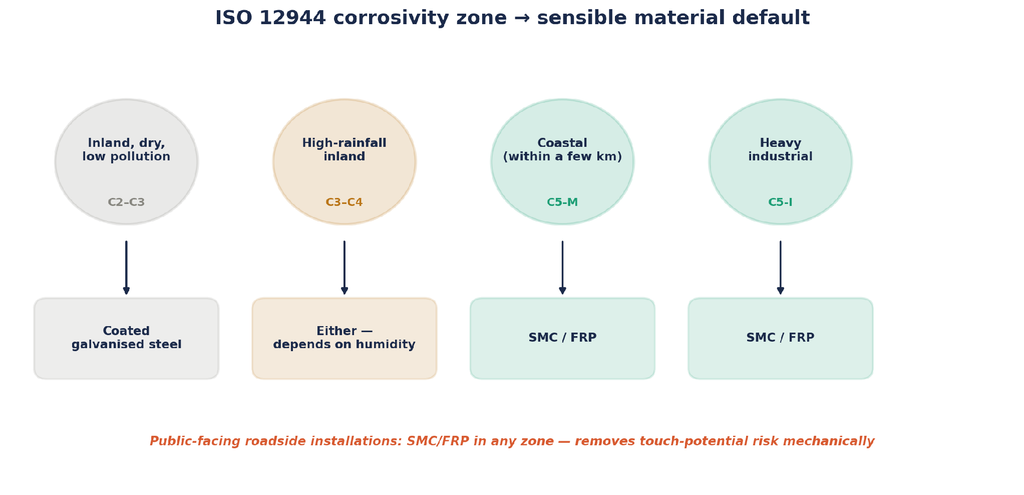
Site corrosivity classification, not brand preference, should drive the material decision
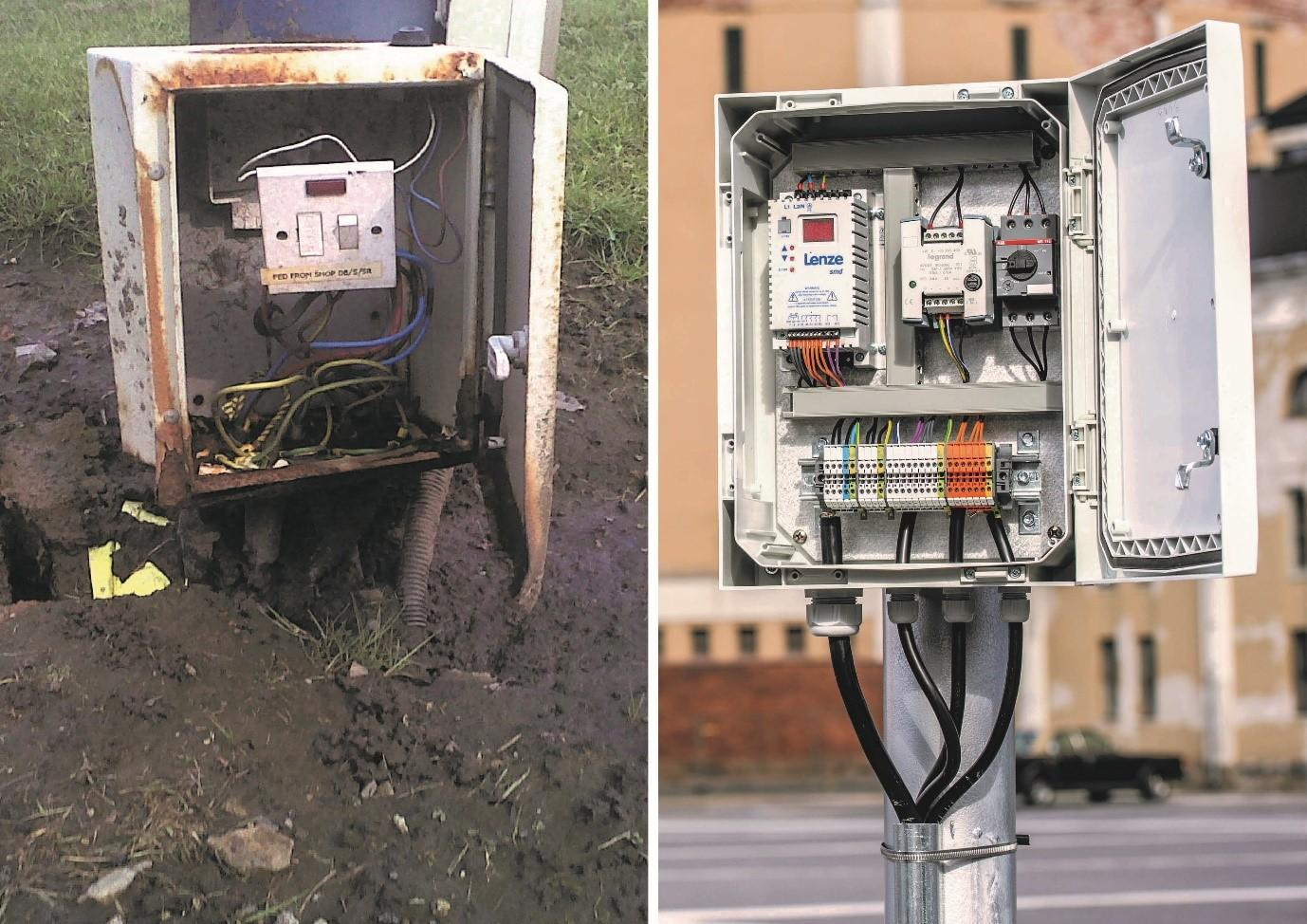
The last row isn’t really about cost. A corroded metal enclosure with degraded insulation on a public footpath can become live during a fault. A non-conductive body cannot. On a public-facing asset, that consideration can override the economics entirely.
Material Properties, Without the Marketing
| Property | Painted MS | Galvanised | SS 316 | SMC / FRP |
|---|---|---|---|---|
| Coastal (C5-M) | Poor | Moderate | Good | Excellent |
| Industrial (C5-I) | Poor | Moderate | Good | Excellent |
| Thermal conductivity | High | High | High | Low |
| Conducts electricity | Yes | Yes | Yes | No |
| Structural strength | High | High | High | Moderate |
| Capital cost | Lowest | Low | Highest | Moderate |
Why Thermal Conductivity Matters More Than It Used To
A metal enclosure in direct sun runs substantially hotter inside than ambient — and that heat now sits on electronics rather than a passive switch-fuse unit. An aluminium electrolytic capacitor loses roughly half its service life for every 10°C above its rating, a widely used electronics-reliability rule of thumb. A hot enclosure is quietly spending the life of everything inside it.
Why Structural Strength Still Favours Steel
Composite is strong enough for most enclosure duty but doesn’t match steel for structural loading — which is exactly why hybrid construction exists.
The Hybrid Case: Which Material, Where
For LT distribution the sharper question is often not “which material” but “which material where.”
A composite envelope with steel reinforcement puts non-conductive, non-corroding material at the interface with weather and the public, and steel where structural load has to be carried. That’s the construction used in Pulse Box™ — an SMC enclosure with mild steel reinforcement.
This is a design-stage decision. You cannot retrofit a material choice — which is why it belongs in a specification, not in a replacement budget five years later.
Frequently Asked Questions
Is FRP better than metal for electrical enclosures?
Not universally. In coastal and heavy-industrial environments, FRP is clearly better on lifetime cost because it removes the corrosion mechanism rather than slowing it. Inland, in dry, low-pollution conditions, coated galvanised steel is cheaper, stronger, and entirely adequate.
How long does an FRP enclosure last compared with steel?
The comparison depends on corrosivity category rather than the material alone. In C5-M coastal conditions, coating life on steel falls sharply while composite is largely unaffected by chloride. In C2-C3 inland conditions, the gap narrows considerably.
Why does thermal conductivity matter in an enclosure?
Because outdoor enclosures now contain electronics. Metal conducts solar heat efficiently into the box, and electronic component life falls sharply with temperature — an electrolytic capacitor loses roughly half its life for every 10°C above rating. Composite’s lower conductivity keeps internal temperatures lower.
Is FRP strong enough for outdoor distribution equipment?
For most enclosure duty, yes. Where higher structural loading is required, hybrid construction — a composite envelope with steel reinforcement — provides composite behaviour at the weather and public interface and steel behaviour where load must be carried.
What should a 25-year cost comparison include?
At minimum: purchase price, installation, recoating cycles, replacement frequency, replacement labour and civil work, outage cost, and the value of the equipment being protected. Most comparisons include only the first two, which structurally favours the cheaper material.
Where to Start
Classify your sites by ISO 12944 corrosivity category before specifying anything. Most utilities issue one national standard specification across every zone, and that single decision explains a large share of premature enclosure failure.
Then, for one representative coastal site and one inland site, work through the cost lines above using your own labour rates and replacement history — the same discipline that matters for LT-side safety and touch-potential risk more broadly.
Read More:
- Mild Steel, Stainless or SMC: What Actually Survives an Indian Monsoon
- 7 Mistakes You’re Making with Transformer Center Safety (And How to Fix Them with FRP Products)
- Why FRP Fencing Will Change the Way You Secure Your Transformer Centers
- Do You Really Need Anti-Theft Meter Boxes? Here’s the Truth About Slashing AT&C Losses

You will likely find the two sites reach opposite conclusions — which is the actual answer, and it is not one a supplier can give you.
RMC Switchgears has built enclosures and distribution equipment for Indian grid conditions since 1994, supplying DISCOMs, OEMs and EPC contractors nationwide from Jaipur.