The Ground Reality: The Hidden Cost of Conventional Fencing
In the expansion of India’s power grid, the perimeter of a substation is often treated as an afterthought: a simple boundary to keep intruders out. However, for DISCOMs and EPC contractors, the choice of fencing material is a critical decision that impacts electrical infrastructure safety, operational uptime, and long-term financial health.
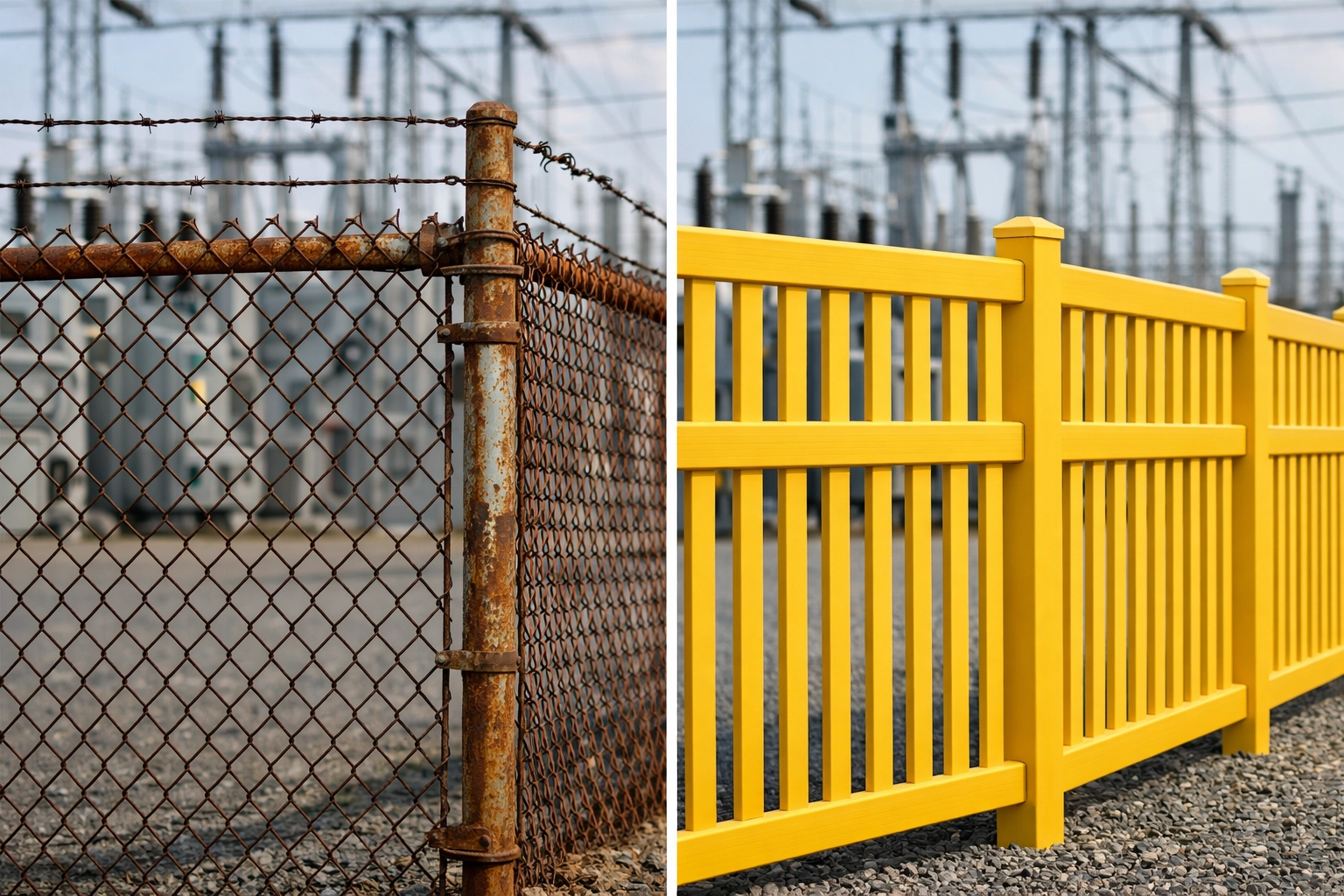
Traditionally, the industry has relied on mild steel (MS) chain-link or heavy concrete walls. While these materials are familiar, they carry inherent systemic flaws. Metal fences are prone to rapid corrosion, require extensive grounding to prevent electrification, and demand a continuous cycle of repainting and repair. Concrete, while sturdy, is labor-intensive to install, difficult to modify, and prone to cracking under seismic or thermal stress.
As we move toward a smarter, more resilient grid, these "legacy" solutions are becoming liabilities. The industry is shifting toward Fiber Reinforced Polymer (FRP) solutions: not just as an alternative, but as a strategic upgrade.
01. The Safety Mandate: Eliminating Conductivity Risks
The most significant risk in any high-voltage environment is the accidental electrification of metallic structures. In a traditional substation layout, every meter of metal fencing must be meticulously earthed to prevent "step and touch" potential hazards. Even with grounding, a fault in the system can turn a perimeter fence into a lethal conductor.
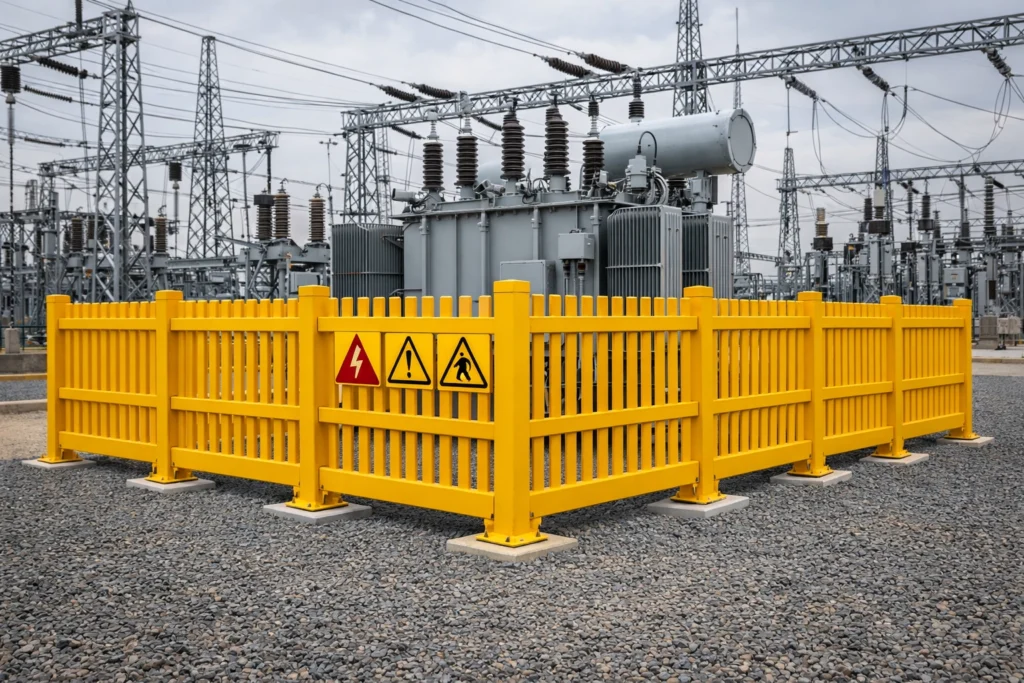
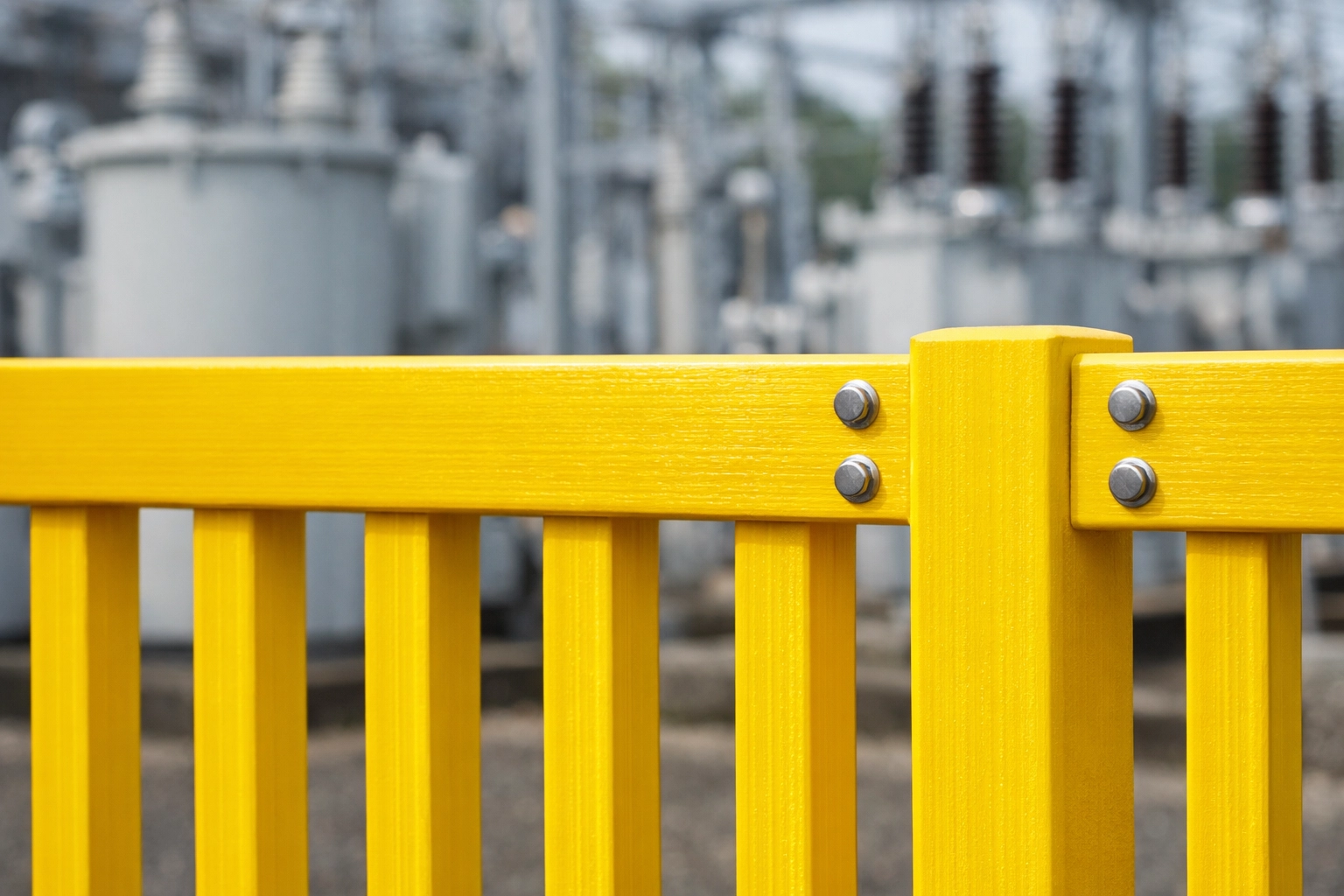
FRP fencing is inherently non-conductive. Because it is made from a composite of high-strength glass fibers and specialized resins, it does not conduct electricity. This "di-electric" property provides a massive safety advantage:
- Zero Grounding Required: Unlike metal, FRP does not need to be integrated into the substation's earthing grid, reducing installation complexity and material costs.
- Touch Safety: In the event of an internal flashover or insulation failure, the fence remains safe to touch, protecting both utility personnel and the general public.
- Interference Free: FRP does not interfere with electromagnetic signals, which is increasingly important as substations integrate more IoT sensors and wireless monitoring equipment like the RMC Pulsebox.
02. The Corrosion Crisis: Why Metal Fails in the Field
India’s geographic diversity presents a nightmare for metal infrastructure. From the salt-laden air of coastal regions to the chemically aggressive environments near industrial hubs, oxidation is a relentless enemy.
Traditional galvanized steel fences typically begin to show signs of "white rust" within 12–18 months. Once the zinc coating is breached, structural oxidation begins, leading to:
- Structural Weakening: Rusted joints and brittle mesh lose their ability to withstand physical impact or high wind loads.
- Aesthetic Decay: A rusted fence reflects poorly on the utility’s commitment to maintenance and professionalism.
- Frequent Replacement: Many DISCOMs find themselves replacing metal fencing every 5–7 years in harsh environments.
FRP products India are engineered specifically to survive these conditions. The resin matrix acts as a chemical shield, making the fencing completely immune to rust, saltwater, and most industrial acids. This chemical inertness ensures a functional lifespan of 25+ years with zero loss in structural integrity.
03. Lifecycle Economics: CAPEX vs. OPEX
When evaluating infrastructure, decision-makers often fall into the trap of focusing solely on the initial Purchase Order (PO) value. However, a true professional analysis looks at the Total Cost of Ownership (TCO).
Comparative Analysis: FRP vs. Conventional Metal
| Feature | Conventional Metal Fencing | FRP Fencing Solutions |
|---|---|---|
| Initial Investment | Moderate | Competitive / Slightly Higher |
| Maintenance Needs | High (Repainting/Descaling every 2-3 years) | Zero (Pigmented through the material) |
| Installation Speed | Slow (Heavy, requires welding/grounding) | Rapid (Lightweight, modular assembly) |
| Electrical Risk | High (Requires earthing) | Non-existent (Inherently insulated) |
| Life Expectancy | 5–10 Years (Environment dependent) | 25+ Years (All environments) |
| Theft Value | High Scrap Value (Prone to theft) | Zero Scrap Value (Theft deterrent) |
By choosing FRP, EPC contractors can offer their clients a "fit and forget" solution. The elimination of the repainting cycle alone covers the price difference within the first 4 years of operation. Furthermore, because FRP has no resale value in the scrap market, it significantly reduces the risk of perimeter breaches caused by local theft: a common headache for rural substations.
04. Tactical Advantages in Installation and Logistics
For an EPC contractor, time on-site is money. Traditional fencing solutions are heavy, requiring cranes for unloading and specialized teams for welding and alignment.
FRP's strength-to-weight ratio is a game-changer. It is approximately 75% lighter than steel while maintaining comparable tensile strength. This leads to a "Consequence Chain" of efficiency:
- Reduced Logistics Costs: More fencing material can be transported in a single truckload, reducing the carbon footprint and freight expenses.
- Ease of Handling: Two workers can easily carry and position an entire 3-meter panel without mechanical assistance.
- No "Hot Work" Permits: Since FRP components are typically bolted or snapped together, there is no need for on-site welding, which is often a safety concern in energized environments.
You can explore our full range of durable infrastructure options on our products and solutions page.
05. Environmental Resilience and Sustainability
As global and national mandates push for greener infrastructure, RMC Switchgears Ltd. is committed to providing materials that align with sustainability goals.
Metal production is energy-intensive and involves heavy carbon emissions. Concrete production is one of the largest contributors to CO2 globally. FRP, while a synthetic composite, offers environmental benefits through its longevity. A fence that lasts 30 years replaces three metal fences that would have needed to be manufactured, transported, and eventually scrapped.
Additionally, FRP is UV-stabilized. Unlike plastics that become brittle and "chalky" under the intense Indian sun, our FRP fencing includes specialized UV inhibitors that protect the polymer chains, ensuring the material remains flexible and strong even after decades of exposure to harsh sunlight.
06. The Deployment Flow: Transitioning to FRP
Switching to FRP does not require a complete redesign of your substation layout. The transition is straightforward:
- Site Assessment: Identify high-risk areas (e.g., proximity to transformers or coastal zones) where metal is failing most rapidly.
- Design Specification: Choose from various mesh sizes or picket designs based on the required security level.
- Modular Assembly: Use pre-engineered connectors and base plates for rapid deployment.
- Verification: Once installed, perform a simple visual inspection. No earthing resistance tests are required for the fence itself.
Our team at RMC Switchgears has been recognized globally for our innovation in this space, recently receiving the Forbes Asia ‘Best Under A Billion’ award, which underscores our commitment to excellence in power distribution infrastructure.
Conclusion: A Strategic Asset, Not Just a Fence
In the modern power sector, durability is the ultimate currency. Every hour spent on maintenance is an hour of lost productivity. Every safety incident is a stain on a utility’s reputation.
By adopting FRP fencing, DISCOMs and EPC contractors are making a statement: they value long-term reliability over short-term savings. They are choosing a material that is as advanced as the smart meters and IoT devices it protects.
At RMC Switchgears Ltd., we don't just provide products; we provide peace of mind. Our FRP solutions are tested to the highest standards to ensure they meet the rigorous demands of the Indian power grid.
Ready to upgrade your infrastructure?
Let’s discuss how FRP fencing can secure your next project.
- Explore our full technical specs: RMC Products
- Connect with our engineering team: Contact Us
- Learn more about our journey: About RMC